Scan a Website in Minutes: AI vs Manual Proofreading

Use AI first to remove mechanical errors, then bring in a human for meaning, tone and high-stakes judgement. That hybrid order beats using either method alone. Quick drafts, internal memos and low-stakes web copy can often stop at the AI pass; anything technical, legal, or reputation-sensitive still needs a trained human eye before it goes out.
TL;DR:
- AI proofreading excels at quickly identifying spelling, punctuation, and grammar errors across large volumes of text at a lower cost.
- Human proofreaders provide contextual judgment, tone control, and adherence to discipline-specific conventions that AI currently cannot reliably replicate.
- Combining an AI mechanical pass with a human review offers the best balance for high-stakes documents like legal contracts, academic papers, or marketing copy.
- AI tools may overcorrect stylistic choices or misinterpret sarcasm, while tired humans can overlook errors, making both methods imperfect alone.
- AI initially benefits routine, low-stakes tasks, but high-stakes content still requires a qualified human reviewer for final quality assurance.
Table of Contents
- Manual proofreading vs AI: what a human proofreader actually catches
- How AI proofreading works and where it wins
- AI vs human editing: a direct comparison of cost, speed and accuracy
- What the research says about AI proofreading accuracy
- When to use AI, when to use a human, and when to combine both
- A step-by-step hybrid proofreading workflow
- Why we back AI-first scanning for website content
- Try the AI-first pass with Websitespellchecker
- Essential reading on proofreading methods and standards
- Sources
Manual proofreading vs AI: what a human proofreader actually catches
Manual proofreading is the final human check of a finished document, done by someone who reads for meaning, not just mechanics. Writers typically hire a human proofreader once a manuscript, report or academic paper is structurally complete and needs a last pass before publication, submission, or print.
What a trained proofreader brings that software still cannot replicate reliably:
- Contextual judgement: spotting a factually wrong but grammatically perfect sentence, such as a date or figure that contradicts an earlier paragraph.
- Tone control: catching when phrasing reads as flippant in a formal report, or stiff in a friendly newsletter.
- Discipline-specific conventions: applying the correct citation format, terminology, or house style for law, medicine, or academic publishing, as Sheffield University’s academic skills guidance sets out.
- Cross-document consistency: noticing that a product name is spelled two different ways across a 40-page brochure.
Costs vary widely by document type and proofreader experience, but freelance proofreaders commonly charge per word or per hour, with turnaround stretching from a same-day rush job to several days for a full manuscript. That cost buys judgement software cannot yet price in.
How AI proofreading works and where it wins
AI proofreading tools combine rule-based grammar checks with natural language processing and, increasingly, large language models trained on huge volumes of edited text. The system flags spelling errors, subject-verb disagreement, punctuation slips, and awkward phrasing by pattern-matching against what correct writing statistically looks like, then suggests a fix instantly.
Where this genuinely beats a human:
- Speed: a full website or manuscript gets scanned in seconds or minutes, not hours.
- Consistency: it applies the same rule to every instance across thousands of pages, with no fatigue setting in on page 300, an advantage practitioner testing on long-document consistency has documented repeatedly.
- Mechanical accuracy: typos, double spaces, and repeated words get caught almost every time.
The limits are just as real. AI can overcorrect a deliberate stylistic choice, misread sarcasm or intentional informality as an error, and confidently rewrite a sentence in a way that quietly changes its meaning. Industry write-ups on AI overcorrection note the tool’s confidence rarely dips even when its comprehension has failed. Our own guide to the best AI proofreading tools breaks down which engines handle which error types best.
AI vs human editing: a direct comparison of cost, speed and accuracy
Match the method to what is actually at stake, not to whichever tool is fastest to open. Mechanical accuracy and contextual judgement pull in different directions, and most projects need both at different stages.
- Mechanical accuracy: AI wins outright on spelling, punctuation, and grammar rule enforcement across large volumes of text.
- Contextual judgement: humans win on meaning, tone, fact-checking, and knowing when a “rule” should be broken deliberately.
- Cost and turnaround: a quick internal email needs neither method beyond a spellcheck; a 1,500-word blog post benefits from an AI pass in minutes; an academic paper or book manuscript still typically needs paid human review running into hours or days.
- Common failure modes: AI’s failure mode is confident wrongness, changing a sentence’s intent without flagging uncertainty. A tired human proofreader’s failure mode is missed repetition, particularly a dropped or duplicated word late in a long document.
The practical consequence: a marketing page with an AI-introduced meaning shift can misrepresent a product; a book manuscript missed by a fatigued human eye can carry a typo through to print. Neither method is loss-proof, which is exactly why relying on just one raises your risk.
What the research says about AI proofreading accuracy
A comparative study found Wordvice AI corrected a majority of the errors identified by professional human editors in the same text, and outperformed Google Docs and Microsoft Word by a notable margin on total errors corrected, according to research published comparing Wordvice AI Proofreader against automated tools and human editors.
The same study reported statistically significant, consistently higher GLEU scores for the AI tool against both standard word processors, a meaningful gap given how widely Word and Docs are used as the default proofreading layer in most offices.
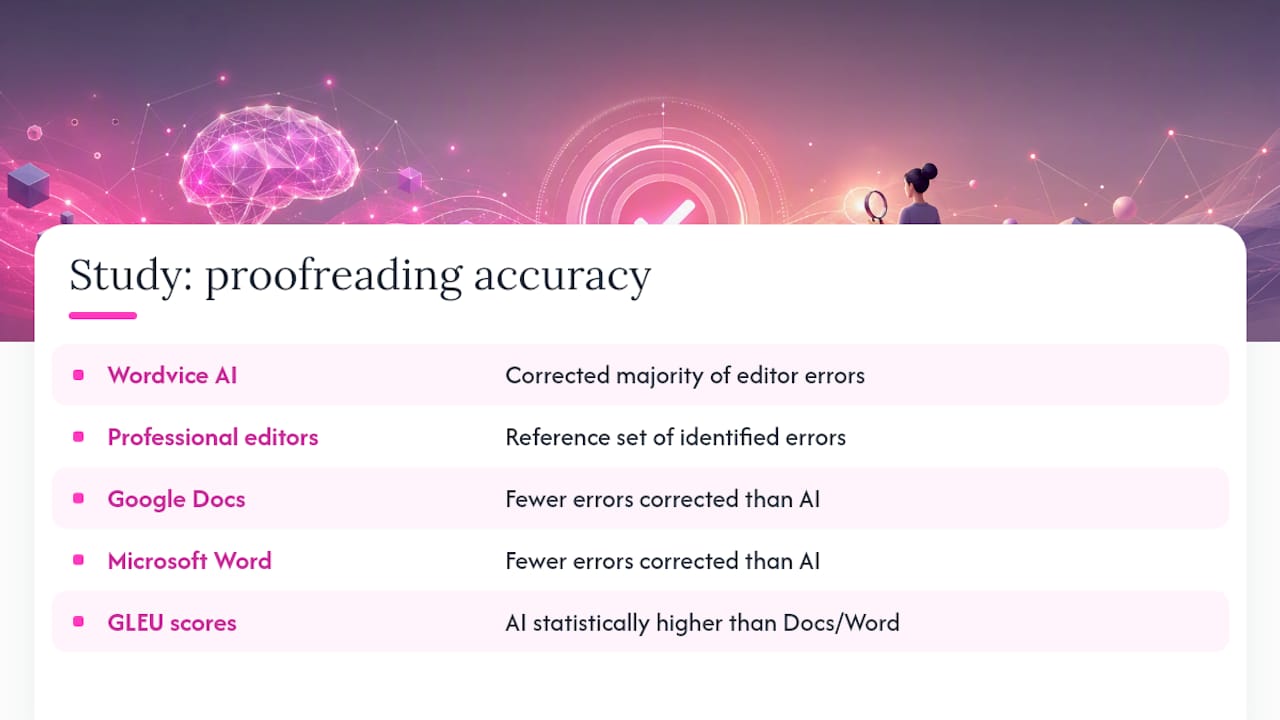
That evidence has real limits. The engine tested was trained specifically on academic-style text, and the study’s own reporting in eScience Editing notes its results apply most directly to that domain, not to marketing copy, creative writing, or legal drafting where voice and persuasion matter more than grammatical correctness. A tool that scores well on catching subject-verb disagreement in a research abstract is not automatically making the right call on whether a headline lands with the right tone.
What this means in practice depends on your document type. An academic author submitting to a journal gets close to human-level mechanical correction from a good AI pass, but still needs a human check for citation formatting and argument coherence. A legal team drafting a contract cannot treat any AI score as a substitute for a qualified reviewer, because the cost of a missed ambiguity is far higher than a missed comma splice. A marketing team writing a landing page sits somewhere in between: AI catches the typos fast, but a human still needs to confirm the copy persuades rather than merely reads correctly.
When to use AI, when to use a human, and when to combine both
Run through four questions before choosing a method: what are the stakes if an error slips through, who is the audience, how long is the document, and how much time do you actually have?
- Low stakes, tight deadline: an internal memo, a Slack update, or a quick social caption. An AI pass alone is usually enough.
- Medium stakes, moderate length: a blog post, a product page, or a newsletter. Run AI first, then a fast human skim for tone and accuracy.
- High stakes, technical or legal content: contracts, medical copy, academic submissions, investor materials. AI first to clear mechanical noise, but a qualified human proofreader has the final say, a point publishers consistently make when comparing human editing against AI proofreading for manuscript-ready work.
- Long-form manuscripts and books: run AI in stages across chapters for consistency, then commission a full human proofread before print.
On cost versus risk: skipping the human pass on a low-stakes memo costs you nothing if AI misses something minor. Skipping it on a contract or a clinical brochure can cost a client relationship or worse. The maths only works in AI’s favour when the downside of an error is small.
Pro Tip: Before you pay a human proofreader, always confirm what stage they’re being asked to work at. Some proofreaders will silently do a full edit, others will strictly flag errors without touching your phrasing, and the price difference between the two can be significant.
A step-by-step hybrid proofreading workflow
- Self-edit for structure first. Read your own draft for logical flow and clarity before any tool touches it. Fixing structure after an AI pass just means re-checking grammar twice.
- Run the AI mechanical pass. Scan the full document or website for spelling, grammar, punctuation and consistency issues, then review every suggestion rather than accepting them in bulk. Practitioner guidance on combining AI grammar checkers with human review consistently backs this order over doing it the other way round.
- Hand it to a human for the final pass. This is where meaning, tone, and fact-checking happen, the layer no current AI reliably owns.
- Add specialised passes where needed. Citations, image alt text, and multi-page website consistency each benefit from a dedicated check, particularly on longer sites where our guide on checking grammar mistakes across website content walks through a practical approach.
Why we back AI-first scanning for website content
We built Websitespellchecker on the belief that mechanical errors should never eat a human editor’s time. Running an automated scan first clears the typos, missing words, and formatting slips across an entire site in one pass, so the people on your team can spend their attention on the judgement calls software still cannot make: tone, accuracy, and whether the page actually persuades.
— Website
Try the AI-first pass with Websitespellchecker
Websitespellchecker exists for exactly the first step in that hybrid workflow: a fast, site-wide mechanical sweep that catches spelling mistakes, grammar errors, and inconsistent phrasing across every page you own, not just the one document open in front of you. Unlike a manual check of each page by eye, or a free spellchecker limited to one screen at a time, it scans an entire website in one go and tracks changes over time, so you always know what has already been fixed.
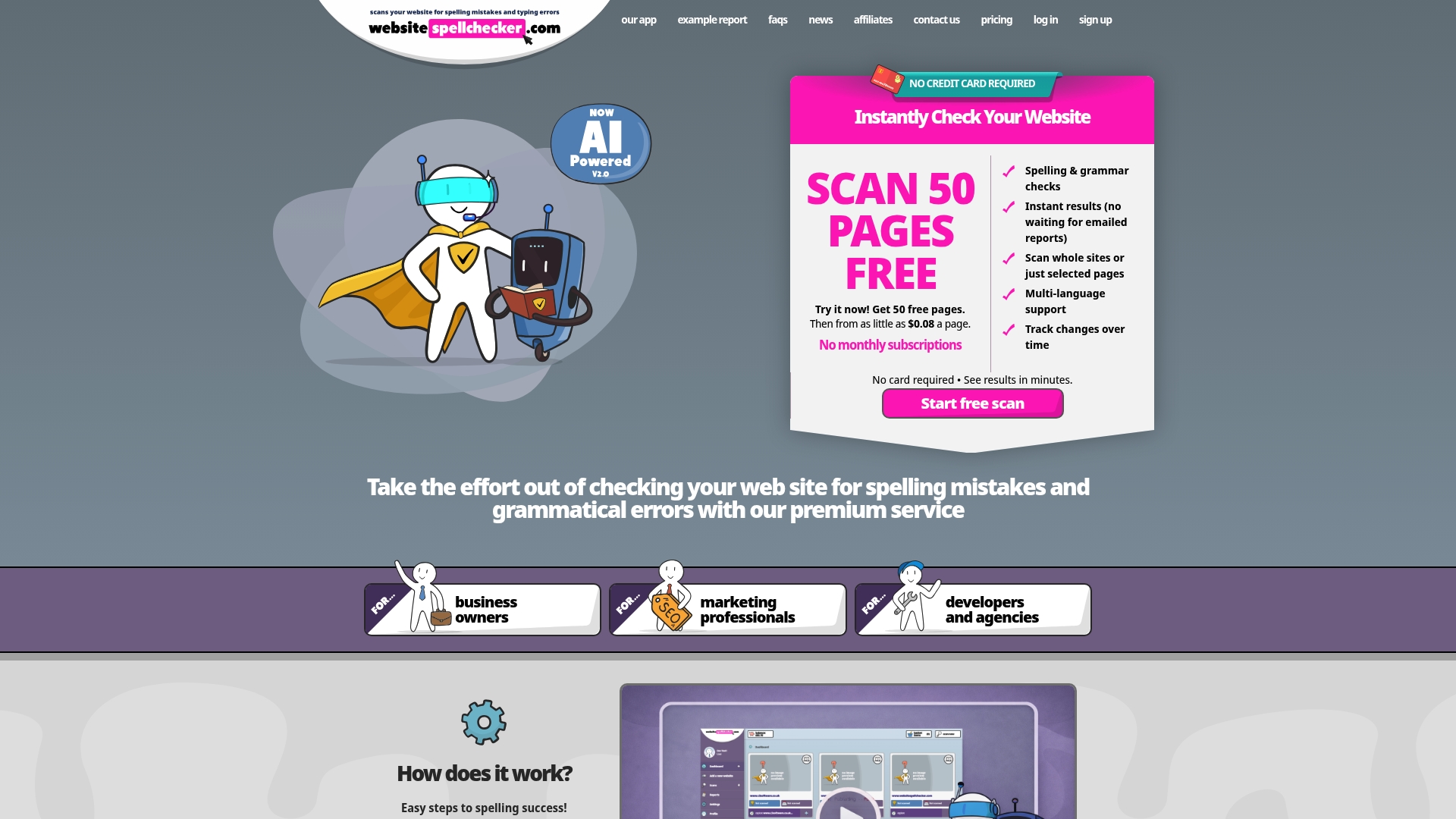
If you run marketing pages, Websitespellchecker’s tools for marketing professionals help keep copy consistent and on-brand across every campaign page. Agencies managing multiple client sites can use the developer and agency features for batch scanning across projects. Start with a free scan, see exactly what it catches on your own site, and decide from there whether the mechanical pass earns its place in your workflow.
Essential reading on proofreading methods and standards
For deeper reading beyond this comparison, start with the Wordvice AI comparative study and Sheffield University’s proofreading guidance. For self-editing before either method, see our guide on how to proofread your own writing.
Sources
- Comparing the accuracy and effectiveness of Wordvice AI Proofreader to two automated editing tools and human editors
- Escienceediting: Wordvice AI Proofreader comparative study
- Sheffield University: proofreading guidance
- Trinka