Brand tone of voice: define, document and apply it

Your brand tone of voice is the way your brand’s personality sounds in words — stable in character, but adjusted in warmth, formality and pace depending on the situation. The fastest next step is to run a short internal workshop, surface 3–5 defining traits, and create “this, not that” examples for each one.
Before that workshop, run this 15-minute audit:
- Pull three recent pieces of copy: a social post, a support reply, and a homepage headline.
- Read them aloud. Do they sound like the same person wrote them? Do they sound like your brand?
- Note any words or phrases that feel off-brand, overly formal, or inconsistent in register.
That quick check tells you whether you have a tone problem worth solving — and almost every team does.
Table of Contents
- What is brand tone of voice, and how does it differ from brand voice?
- Why tone of voice matters for recognition, trust and conversion
- What shapes your brand’s tone?
- A practical 6-step process to define your brand tone of voice
- Five brands that get tone right — and what you can copy
- How to apply your tone across channels
- How to govern tone: training, audits and KPIs
- Evidence-backed best practices for tone of voice
- Keep your tone consistent: what to do this week
- Key takeaways
- The mistake most brands make with tone of voice
- One more thing: your copy needs to match your tone
What is brand tone of voice, and how does it differ from brand voice?
Voice and tone are distinct: voice is your brand’s stable personality, and tone is the situational dial you turn depending on context. Think of it this way: your voice is who you are; your tone is how you sound in a given moment.
Microsoft’s own style guidance frames it clearly: there is what you say (your message) and how you say it (your voice). The voice stays constant; the tone adapts. A brand that sounds warm and direct in a product announcement should still sound warm and direct in a support article, even if the pace slows and the formality rises slightly.
| Dimension | Brand voice (stable) | Brand tone (variable) |
|---|---|---|
| Definition | Core personality and verbal identity | Situational emotional inflection |
| Changes with context? | No | Yes |
| Key elements | Lexicon, cadence, point of view | Warmth, formality, pace, humour level |
| Documented where? | Voice brief (1–2 pages) | Tone framework / context matrix |
In practice, the difference looks like this:
- Voice example (stable): “We make complex things simple.” That sentence could appear on the homepage, in a job ad, or in a help article.
- Tone shift (same voice, different context): A product launch post might read: “Your new dashboard is here. Faster, cleaner, yours.” A system-outage notice from the same brand reads: “We’re aware of an issue affecting your account. Our team is working on it now.” Same directness, same clarity. Different warmth, different pace.
Conflating voice and tone is one of the most common failures in brand documentation. The fix is two complementary documents: a short voice brief and a one-page tone framework that maps recurring contexts to dial settings.
Why tone of voice matters for recognition, trust and conversion
90% of consumers say trust is important when they interact with brands. Consistent voice and tone are among the most direct levers you have to build that trust, because they signal reliability before a customer has even used your product.
The business case goes further than brand recognition:
- Conversion: Copy that sounds confident and clear reduces friction at decision points. A confused or inconsistent tone creates doubt, and doubt kills conversions.
- Support satisfaction: Teams with documented tone guidelines resolve tickets faster because writers spend less time second-guessing register. Fewer escalations follow.
- Internal efficiency: A well-documented voice and tone system reduces review cycles and off-brand output, freeing up time for higher-value work.
Tone also protects you in high-stakes moments. A brand that sounds flippant during a service outage, or stiff and corporate in a social campaign, loses the trust it spent months building. Website trust signals extend beyond design and security badges — the words you choose carry equal weight.
What shapes your brand’s tone?
Four inputs determine what your tone should sound like. Get these right, and every subsequent decision becomes easier.

Audience persona. Your tone should mirror how your audience speaks, not how you wish they spoke. A fintech brand targeting first-time investors needs plain language and reassurance. A developer tool targeting senior engineers can afford more precision and less hand-holding. Interview real customers, read their support tickets, and note the words they use to describe their problems.
Brand values and personality. Your values set the guardrails. If one of your values is “honest,” your tone cannot be evasive or overly polished. If “playful” is a core trait, your legal notices can still be clear and compliant while carrying a lighter touch in their phrasing.
Category expectations and risk profile. Financial services, healthcare, and legal brands operate under higher trust expectations than, say, a lifestyle app. Your tone must meet the category’s baseline before it can differentiate. A challenger bank can be warmer and more direct than a traditional lender, but it cannot be cavalier about money.
Channel and content type. The same brand sounds different across channels, and that is correct behaviour, not inconsistency.
- Social media: shorter sentences, lighter register, more personality.
- Email marketing: direct subject lines, moderate warmth, clear call to action.
- Help centre articles: calm, precise, step-by-step. Empathy without drama.
- In-app microcopy: ultra-concise, action-oriented, no jargon.
- Legal notices: formal, but still readable. Plain English where the law allows.
Localisation. If you operate across markets, your core voice stays intact while tone adapts to cultural norms. British audiences tend to respond well to understatement and dry wit; US audiences often prefer more explicit enthusiasm. Neither is wrong — they are different dials on the same instrument.
A practical 6-step process to define your brand tone of voice
This process works for a team of two or a cross-functional group of twelve. Budget 2–4 weeks for a small-to-medium organisation.
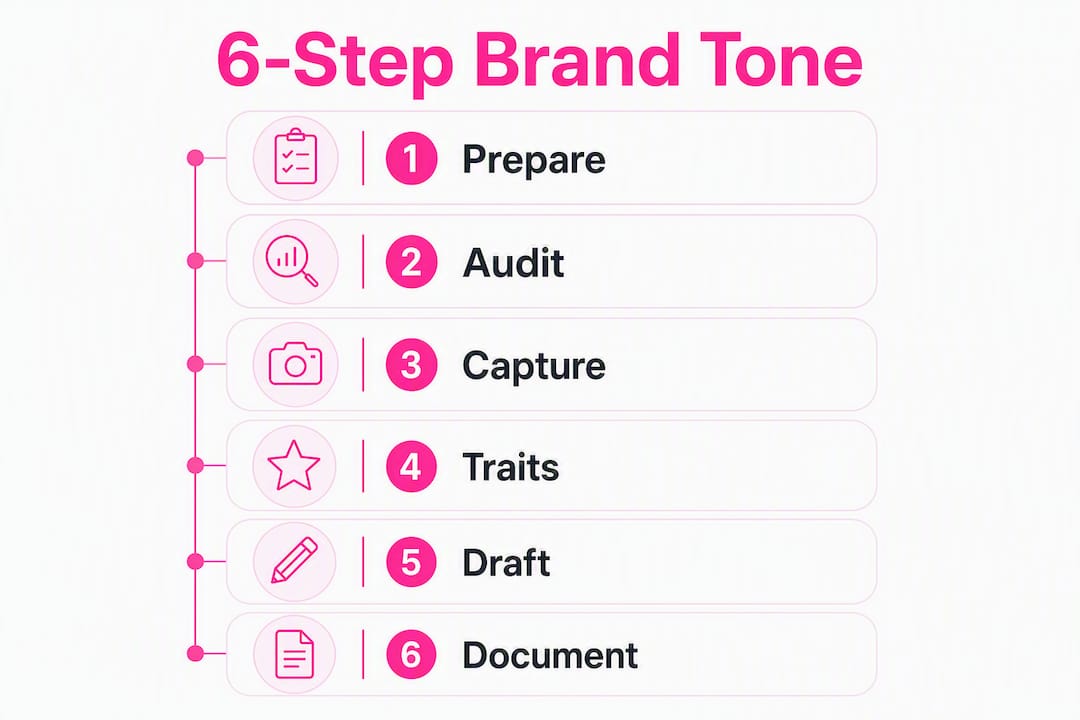
Step 1: Prepare and align stakeholders
Gather representatives from marketing, product, customer support, and leadership. Brief them with a single question before the workshop: “If our brand were a person, how would you describe them at a dinner party?” Collect answers in advance. Patterns in those answers become your starting traits.
Deliverable: A pre-workshop brief with three to five candidate personality descriptors.
Step 2: Audit existing content
Pull 10–15 pieces of live copy across channels. Rate each one on a simple scale: does it sound like the brand you want to be? Starting from your mission and auditing top content before codifying anything is the approach recommended by most brand practitioners, and it prevents you from building a guide that bears no relation to your actual output.
Deliverable: A content audit spreadsheet with a “sounds like us / doesn’t sound like us” column.
Step 3: Capture audience language
Review customer support tickets, sales call transcripts, and social mentions. Note the exact words your audience uses to describe their problems and goals. Your tone should feel familiar to them, not foreign.

Deliverable: A vocabulary list of 20–30 words and phrases your audience uses naturally.
Step 4: Select 3–5 core traits
Industry best practice recommends identifying 3–5 core traits and giving each one a concrete “this, not that” example. More than five traits become impossible to remember; fewer than three leave too much room for interpretation.
For each trait, write:
- A one-sentence definition.
- A “this” example (on-brand).
- A “not that” example (off-brand).
Example trait card:
| Trait | Definition | This | Not that |
|---|---|---|---|
| Direct | We say what we mean without padding. | “Your trial ends on Friday.” | “Please be advised that your trial period will be concluding at the end of this week.” |
| Warm | We sound like a helpful colleague, not a corporate notice. | “Got a question? We’re here.” | “For enquiries, please contact our support department.” |
Step 5: Draft “this, not that” pairs and channel snippets
For each trait, produce at least one “this, not that” pair per major channel. This is the most practical output of the whole process — writers reach for these first.
Pro Tip: Run a blind test: give three writers the same brief and ask them to write a support reply using only the trait cards. Compare outputs. Where they diverge, your documentation needs more specificity.
Step 6: Document and centralise
Compile everything into a single voice and tone guide. Keep the voice brief to one or two pages; the tone framework can be longer, but every page must earn its place with real examples. Practical templates for UK teams can accelerate this step considerably.
Deliverable checklist:
- Voice brief (1–2 pages): traits, definitions, “this, not that” pairs.
- Tone framework: context matrix mapping scenarios to dial settings.
- Channel snippets: one-liners for social, email, help centre, in-app, legal.
- Onboarding pack: a one-page summary for new writers and agencies.
Five brands that get tone right — and what you can copy
1. Mailchimp: clarity over cleverness
Mailchimp’s style guide is one of the most-cited examples in the industry, and for good reason. Their core principle is “clear over clever” — wit is welcome, but never at the expense of utility. In a support context, Mailchimp drops the jokes entirely and leads with empathy and precision.
This, not that:
- This: “Something went wrong. Here’s what to do next.”
- Not that: "Oops! Looks like our little elves had a hiccup. "
The lesson for UK B2B teams: playfulness has a place, but it earns its place. In a high-stakes moment, clarity is the kindest thing you can offer.
2. Innocent Drinks: warmth with wit
Innocent built its brand almost entirely on tone. Their copy is conversational, self-aware, and occasionally absurd — but it never loses sight of the product. The wit is grounded in genuine warmth, not performance.
Channel shift: On packaging, Innocent is playful and verbose. On their website’s FAQ, the same warmth shows up in shorter, more direct answers. The personality is consistent; the pace changes.
Copy from them: Use first-person plural (“we”), avoid corporate nouns, and let a little personality into unexpected places (the bottom of a receipt, an error message, a cookie notice).
3. Monzo: direct, human, and jargon-free
Monzo’s tone is a masterclass in making financial language feel approachable without dumbing it down. They write the way a knowledgeable friend would explain a bank transfer — direct, honest, and free of the passive-voice hedging that plagues most financial copy.
Before/after:
- Before (traditional bank): “Funds will be credited to your account within three to five working days, subject to standard processing times.”
- After (Monzo style): “Money usually arrives in 1–3 working days. We’ll let you know when it lands.”
For any brand in a regulated category, Monzo proves you can be compliant and human at the same time.
4. Slack: conversational but never casual
Slack’s in-app copy is a study in microcopy discipline. Every error message, empty state, and onboarding prompt sounds like a helpful colleague — never a robot, never a comedian. Their tone is warm but purposeful, and they resist the temptation to over-explain.
What to copy: Write in-app messages as if you are standing next to the user. “You’re all caught up” is better than “No new notifications at this time.” Short, human, and reassuring.
5. Notion: calm, confident, and quietly inspiring
Notion’s tone is understated. They do not shout about features; they describe them as if they are obvious and inevitable. The effect is confidence without arrogance — a tone that suits a productivity tool used by everyone from students to enterprise teams.
This, not that:
- This: “Build your wiki, your way.”
- Not that: “Unlock the power of collaborative knowledge management with our next-generation platform.”
The restraint is the point. If your product is genuinely good, your copy does not need to oversell it.
How to apply your tone across channels
Consistent tone does not mean identical copy. Here is how to adapt without losing coherence.
Social media
- Do: use short sentences, active verbs, and a conversational opener.
- Do: let personality show in word choice, not just emoji.
- Don’t: use jargon, passive voice, or corporate sign-offs (“Please find below…”).
- Don’t: be so casual that you lose credibility.
Example: “Your website has a typo. We found it so you don’t have to.” (Direct, light, on-brand.)
- Do: write subject lines that state the benefit plainly (“Your scan report is ready”).
- Do: open with the most important point, not a preamble.
- Don’t: use “I hope this email finds you well” or similar filler openers.
- Don’t: bury the call to action below three paragraphs of context.
Help centre and support replies
- Do: lead with empathy, then move to the solution.
- Do: use numbered steps for anything with more than two actions.
- Don’t: use humour in incident responses or billing disputes.
- Don’t: use passive voice (“the issue was caused by”) when you can own it (“we had an issue with”).
In-app microcopy
- Do: be ultra-concise. Every word must earn its place.
- Do: use action verbs for buttons (“Start scan”, not “Scan initiation”).
- Don’t: use negative phrasing (“Don’t forget to save”) when positive works (“Save your progress”).
Legal notices
- Do: use plain English wherever the law permits.
- Do: keep sentences short and structure with headers.
- Don’t: abandon your brand’s clarity principles just because the content is legal.
Vocabulary guidance: Maintain a preferred-words list (e.g. “check” not “verify”, “fix” not “remediate”, “you” not “the user”) and a banned-words list (e.g. “synergy”, “leverage”, “utilise”). For UK audiences, prefer British spellings and idioms throughout. Marketing professionals managing multi-channel campaigns benefit most from having this list in a shared document everyone can access.
How to govern tone: training, audits and KPIs
Good documentation is only half the job. Governance is what keeps tone consistent when teams grow, agencies rotate, and campaigns multiply.
Training formats and cadence
New writers should complete a tone induction before publishing anything. This does not need to be a full-day session — a 45-minute walkthrough of the voice brief, followed by a writing exercise using the “this, not that” pairs, is enough to set expectations. For agencies and freelancers, share the onboarding pack and require a sample piece before briefing live work.
Run a refresher session quarterly, or whenever a significant campaign or product launch is approaching. Documenting voice reduces off-brand content and speeds up approvals, but only if the documentation is actively used rather than filed away.
Audit checklist
Conduct a tone audit quarterly. Sample at least 10 pieces of copy per channel and score each one against your traits.
| Audit dimension | Score 1–5 | What a low score looks like | What a high score looks like |
|---|---|---|---|
| Warmth | 1–5 | Cold, transactional, impersonal | Friendly, empathetic, human |
| Formality | 1–5 | Stiff, jargon-heavy, passive | Clear, direct, appropriately casual |
| Clarity | 1–5 | Vague, padded, hard to scan | Precise, concise, easy to act on |
| Consistency | 1–5 | Varies by writer or channel | Recognisably the same brand everywhere |
A score of 3 or below on any dimension flags a training or documentation gap. Scores of 4–5 across all dimensions indicate a healthy, well-governed tone.
KPIs to track
- Voice-consistency score: average audit score across channels, tracked quarterly.
- CSAT changes: monitor customer satisfaction scores before and after a tone refresh.
- Conversion lift: A/B test on-brand copy against off-brand variants on key landing pages.
- Review cycle time: track how long copy takes to approve. A well-documented tone should reduce rounds of revision.
Evidence-backed best practices for tone of voice
The research on brand voice converges on a short list of principles that hold across industries and team sizes.
Best-practice checklist:
- Document 3–5 traits with concrete “this, not that” examples in a centralised guide.
- Map tone to context: create a matrix of recurring scenarios and their dial settings.
- Prioritise clarity over cleverness, especially in support and product contexts.
- Audit tone quarterly and score against a rubric to make subjective judgements objective.
- Train every writer — internal and external — before they publish.
90% of consumers say trust is important when they interact with brands, and consistent tone is one of the most direct ways to signal that your brand is trustworthy. Brands that document their voice and audit it regularly produce more consistent output and spend less time in revision cycles.
Pro Tip: Use your tone-scoring rubric (warmth, formality, clarity, consistency, each scored 1–5) during peer reviews, not just formal audits. When a writer submits copy, ask them to self-score it first. The gap between self-score and reviewer score reveals exactly where the documentation needs more examples.
For teams managing copy across an entire website, an automated scan can catch the surface-level errors that undermine tone before they go live. B2B SaaS proofreading tools that flag inconsistent phrasing, spelling errors, and awkward constructions give your governance process a practical safety net.
Keep your tone consistent: what to do this week
Your brand’s tone of voice is only as good as the actions you take to define, document and maintain it. Here is a prioritised checklist.
In the next 24 hours:
- Run the 15-minute audit described at the top of this article.
- Note the three biggest inconsistencies you find.
In the next week:
- Schedule a 90-minute workshop with stakeholders from marketing, product and support.
- Draft three candidate traits and one “this, not that” pair for each.
In the next month:
- Complete all six steps of the framework above and produce a voice brief and tone framework.
- Share the onboarding pack with every writer, agency, and freelancer who touches your copy.
- Run your first formal tone audit and record the baseline scores.
The internal documents to update first are your style guide, your onboarding pack for new writers, and any agency briefs currently in circulation. If you have a brand consistency checklist, add tone-scoring to it now.
Key takeaways
A consistent brand tone of voice, documented with 3–5 traits and a context-mapped tone framework, is the most practical way to build trust and reduce off-brand output across every channel.
| Point | Details |
|---|---|
| Voice vs tone | Voice is your stable personality; tone is the situational dial you adjust by channel and context. |
| Trust and consistency | 90% of consumers say trust matters when interacting with brands; consistent tone is a direct lever. |
| Document 3–5 traits | Name each trait, define it, and give a “this, not that” example to make it usable for writers. |
| Govern with audits | Score copy quarterly on warmth, formality, clarity and consistency using a 1–5 rubric. |
| Train before publishing | Every writer, internal or external, should complete a tone induction before producing live copy. |
The mistake most brands make with tone of voice
The most common failure is not having no tone guide — it is having one that nobody uses. Teams spend weeks in workshops, produce a beautifully designed PDF, and then file it somewhere it is never opened again. The guide becomes a governance theatre piece rather than a working tool.
The second most common mistake is trying to be everything to everyone. A brand that wants to sound “professional but approachable, playful but authoritative, bold but reassuring” has not made any decisions at all. A distinct point of view is more effective than trying to appeal to everyone — the brands that resonate most strongly are the ones willing to exclude some audiences in order to connect deeply with the right ones. Innocent Drinks does not try to sound like a bank. Monzo does not try to sound like Innocent.
The third mistake is forced delight. Playful language in a billing dispute, ironic copy in a system outage, emoji in a data breach notification — these are not expressions of brand personality. They are tone-deaf, and they damage trust faster than any spelling error. Mailchimp’s guidance on this is worth reading in full: reserve humour for contexts where trust is already established, and prioritise empathy and clarity everywhere else.
For B2B SaaS teams specifically, the practical advice is this: start with clarity, then add personality. A support article that is warm but confusing is worse than one that is neutral but clear. Get the utility right first; the voice will follow naturally once the structure is sound.
Tone also drifts. It drifts when teams grow, when agencies change, when a new CMO arrives with different instincts. The antidote is not a better PDF — it is a live, audited, scored process that treats tone as a measurable output rather than a creative preference. Build the rubric. Run the audits. Track the scores. That is what separates brands with a genuine voice from brands with a document about one.
One more thing: your copy needs to match your tone
You can define the most precise, well-documented tone of voice in your industry — and still undermine it with a typo on your homepage. Spelling errors and grammatical mistakes signal carelessness, and carelessness contradicts every trust signal your tone is trying to build.
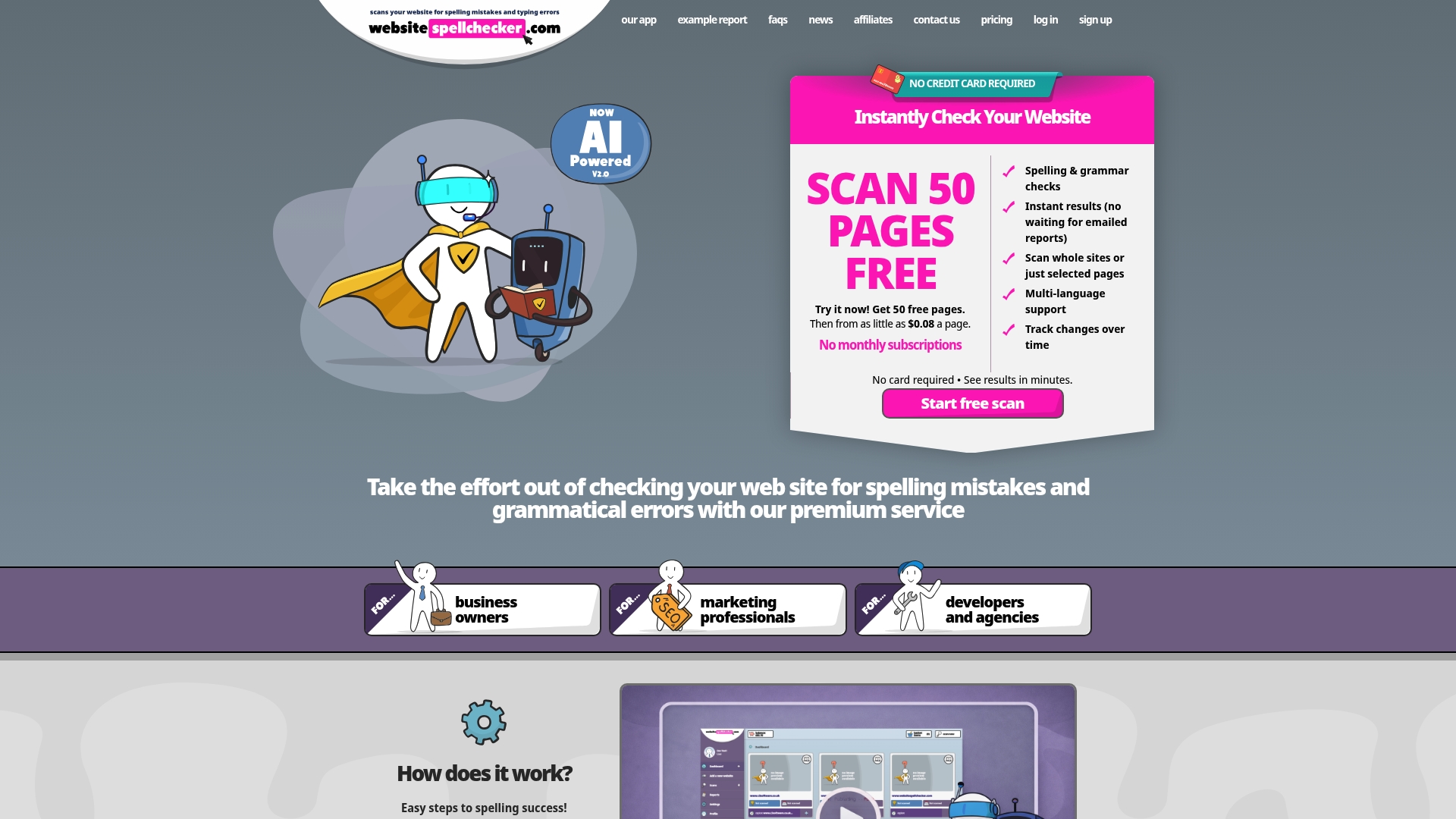
Websitespellchecker scans your entire website for spelling mistakes, grammatical errors, inconsistent phrasing, and missing words — across every page, in one go. The results arrive instantly, with a detailed report you can share with your team or agency. For marketing professionals and business owners who have invested in defining their brand’s voice, it is the practical safety net that keeps the copy as polished as the strategy behind it.