Canadian vs American spelling: a practical guide for writers

For most Canadian content, adopt the hybrid standard the Canadian Oxford Dictionary recommends: prefer British-style noun endings such as colour and centre, but use -ize verb endings and American-influenced forms where Canadian usage has settled there. Consistency within a document matters more than perfect alignment with either British or American forms.
The three patterns you will encounter most often:
- -our vs -or: Canada prefers colour, honour, labour (British forms) over the American color, honor, labor.
- -re vs -er: Canada prefers centre, theatre, litre over center, theater, liter.
- -ize vs -ise: Canada generally favours -ize endings (organize, recognize) rather than the British -ise.
Three authoritative references to keep open whenever a choice is unclear: the Canadian Oxford Dictionary (primary authority), the Gage Canadian Dictionary, and the Collins Canadian Dictionary. When a Canadian Oxford entry lists two spellings, the first-listed form is the most common Canadian usage.
Key takeaways
Canadian English is a hybrid standard: follow the Canadian Oxford Dictionary’s primary forms, favour -our and -re endings, use -ize not -ise, and enforce your chosen standard with en-CA tool settings and periodic site scans.
| Point | Details |
|---|---|
| Canadian English is a hybrid | It favours British noun endings (-our, -re) but American verb endings (-ize) and simplified digraphs. |
| Use the Canadian Oxford Dictionary | Choose the first-listed spelling; it represents the most common Canadian form. |
| Consistency beats perfection | Mixing neighbour with labor in one document signals carelessness; pick one standard and apply it throughout. |
| Set tools to en-CA | Word processors, browsers, and CMS platforms default to US English; change every language setting deliberately. |
| Websitespellchecker enforces it at scale | A sitewide scan catches regional-spelling regressions across all pages, with a downloadable report for your team. |
Table of Contents
- What are the main Canadian vs American spelling patterns?
- A reference table of common Canadian and American word pairs
- When does Canadian English follow British forms, and when does it follow American?
- How should you choose a spelling standard and keep it consistent?
- Which Canadian references and style guides should you consult?
- How do you enforce your chosen spelling across an entire website?
- Why consistency matters more than you might think
- Catch every regional spelling error across your whole site
- Sources
What are the main Canadian vs American spelling patterns?
Canadian English sits between British and American norms, and the patterns are largely predictable. Once you know the suffix rules, you can make the right call on most words without reaching for a dictionary every time.
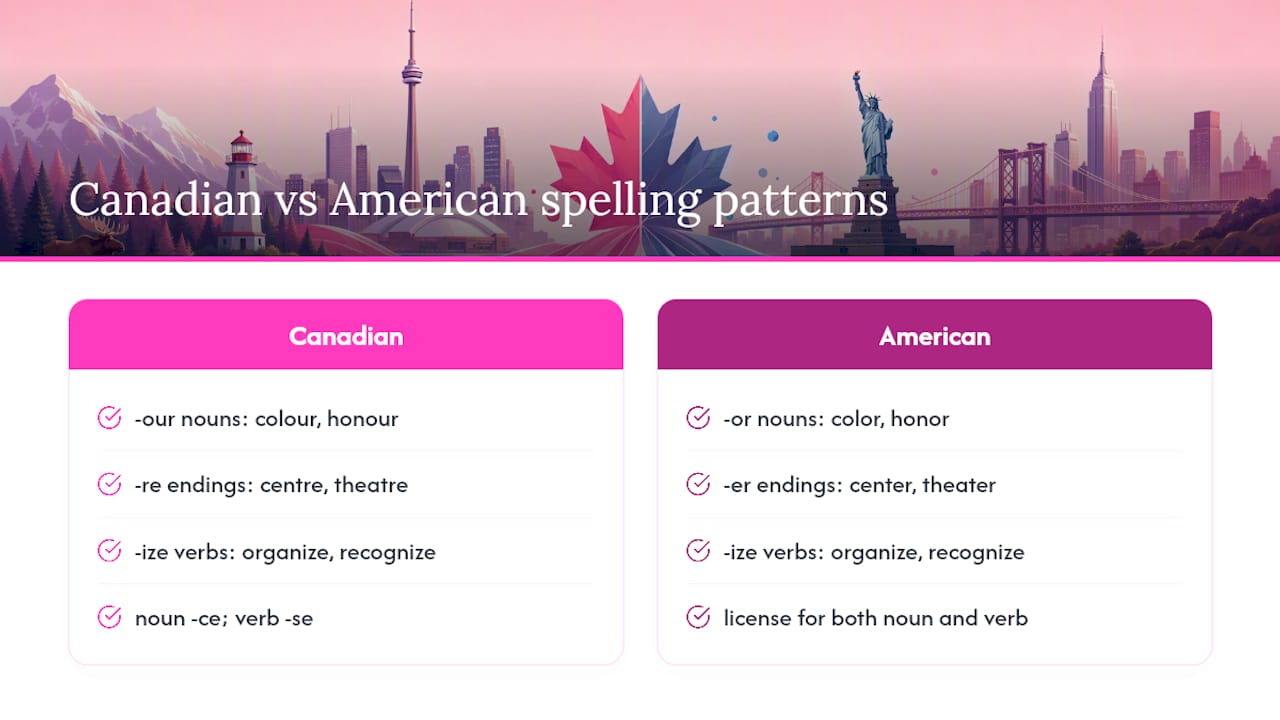
-our / -or Canada uses -our for most nouns: colour, honour, labour, neighbour, flavour, humour, odour, vapour. American English drops the u throughout. One small exception worth noting: odour is standard Canadian, but you will occasionally see odor in scientific or technical writing even in Canada.
-re / -er Canada keeps the British -re ending: centre, theatre, litre, metre, fibre, calibre, spectre. American English reverses the letters to -er. This distinction is consistent and rarely causes confusion.
-ize / -ise Here Canada parts ways with British English. Canadian writers typically use -ize (organize, recognize, analyze, prioritize), matching American practice. The -ise ending (organise, recognise) is the British preference and looks out of place in Canadian copy.
-ce / -se noun and verb distinction Canadian English preserves the British rule of using -ce for the noun and -se for the verb. So: licence (noun) but license (verb); practice (noun) but practise (verb). American English uses license and practice for both forms, which is a common source of errors in Canadian documents.
Doubled consonants Canada follows British conventions for doubled consonants before suffixes: travelling, modelling, labelled, counsellor. American English keeps the single consonant: traveling, modeling, labeled, counselor.
ae / oe digraphs Canadian English has largely moved toward the simplified American forms: encyclopedia rather than encyclopaedia, anemia rather than anaemia, estrogen rather than oestrogen. This aligns Canada with American usage and differs from traditional British practice.
Cheque / check Canada uses cheque for a bank payment instrument, matching British usage. Check is the American form. This is one of the most frequently confused pairs in cross-border content.
The Government of Canada’s Language Portal notes that Canadians typically prefer British spellings in categories like -our and -re, while American forms are common for verb endings and digraphs. The practical takeaway: no single rule covers everything, which is exactly why a Canadian dictionary is your most reliable tool.
A reference table of common Canadian and American word pairs
The table below covers the highest-value examples across all major pattern types. The “Canadian preferred” column reflects the primary entry in the Canadian Oxford Dictionary and Government of Canada guidance; the “Note” column flags tricky cases.
| Pattern | Canadian preferred | American spelling | Note |
|---|---|---|---|
| -our/-or | colour | color | Standard across all -our words |
| -our/-or | honour | honor | Also: honourable |
| -our/-or | labour | labor | Labour Party (political) |
| -our/-or | neighbour | neighbor | Also: neighbourhood |
| -our/-or | flavour | flavor | Consistent in food/recipe writing |
| -our/-or | humour | humor | Also: humorous (no u) |
| -our/-or | odour | odor | Odor sometimes appears in Canadian scientific texts |
| -our/-or | vapour | vapor | Consistent Canadian form |
| -our/-or | behaviour | behavior | Also: behavioural |
| -our/-or | harbour | harbor | Consistent Canadian form |
| -re/-er | centre | center | Centre is standard in Canadian place names |
| -re/-er | theatre | theater | Theatre is preferred in arts/culture contexts |
| -re/-er | litre | liter | Official Canadian measurement unit spelling |
| -re/-er | metre | meter | Metre for unit; meter for measuring device |
| -re/-er | fibre | fiber | Consistent Canadian form |
| -re/-er | calibre | caliber | Consistent Canadian form |
| -re/-er | spectre | specter | Consistent Canadian form |
| -re/-er | sombre | somber | Consistent Canadian form |
| -ize/-ise | organize | organise | Canada uses -ize, not -ise |
| -ize/-ise | recognize | recognise | Canada uses -ize |
| -ize/-ise | prioritize | prioritise | Canada uses -ize |
| -ize/-ise | analyze | analyse | Canada uses -yze, not -yse |
| -ize/-ise | paralyze | paralyse | Canada uses -yze |
| -ce/-se | licence (n) | license (n/v) | Canada: licence = noun only |
| -ce/-se | license (v) | license (n/v) | Canada: license = verb only |
| -ce/-se | practice (n) | practice (n/v) | Canada: practice = noun only |
| -ce/-se | practise (v) | practice (n/v) | Canada: practise = verb only |
| -ce/-se | offence | offense | Canada keeps -ce |
| -ce/-se | defence | defense | Canada keeps -ce; note: defensive uses -s- |
| -ce/-se | pretence | pretense | Canada keeps -ce |
| Doubled consonants | travelling | traveling | Canada doubles the l |
| Doubled consonants | modelling | modeling | Canada doubles the l |
| Doubled consonants | labelled | labeled | Canada doubles the l |
| Doubled consonants | counsellor | counselor | Canada doubles the l |
| Doubled consonants | jewellery | jewelry | Canada uses jewellery |
| Doubled consonants | fulfil | fulfill | Canada uses single l; fulfil is preferred |
| Cheque/check | cheque | check | Cheque = bank payment; check = other meanings |
| ae/oe digraphs | encyclopedia | encyclopaedia | Canada uses simplified form |
| ae/oe digraphs | anemia | anaemia | Canada uses simplified form |
| ae/oe digraphs | estrogen | oestrogen | Canada uses simplified form |
| ae/oe digraphs | fetus | foetus | Canada uses simplified form |
| ae/oe digraphs | maneuver | manoeuvre | Canada retains -oeuvre here |
| Miscellaneous | program | programme | Program for software; programme for events/TV |
| Miscellaneous | grey | gray | Canada uses grey |
| Miscellaneous | tyre | tire | Canada uses tire (American form) |
| Miscellaneous | storey | story | Storey = floor of a building |
| Miscellaneous | cheque | check | Bank instrument only |
| Miscellaneous | plough | plow | Canada uses plow (American form) |
A few derived forms worth noting separately:
- Colour → colourful, colourless, colouring (all retain the u)
- Honour → honourable, honorary (note: honorary drops the u)
- Humour → humorous (the u disappears before -ous)
- Travel → travelling, travelled, traveller (doubled l throughout)
When does Canadian English follow British forms, and when does it follow American?
Canadian English developed as a transitional variety, shaped by two competing forces: historical ties to Britain through colonial settlement and immigration, and geographic and cultural proximity to the United States. Noah Webster’s spelling reforms in the early nineteenth century standardised American English, but those reforms never fully crossed the border. Canada kept many British forms while absorbing American vocabulary and, gradually, some American spellings.
Where Canada tends toward British forms
- Noun endings: -our (colour, honour, labour) and -re (centre, theatre, litre)
- The -ce/-se noun/verb distinction: licence/license, practice/practise
- Doubled consonants before suffixes: travelling, modelling, labelled
- Cheque for a bank instrument
- Grey rather than gray
- Storey for a floor of a building
Where Canada tends toward American forms
- Verb endings: -ize rather than -ise (organize, recognize)
- -yze rather than -yse (analyze, paralyze)
- Simplified digraphs: encyclopedia, anemia, estrogen, fetus
- Tire rather than tyre
- Plow rather than plough
- Program for software (though programme survives for broadcast schedules and events)
Exceptions that catch writers out
Exposure to American media and default software settings set to US English has pushed younger Canadian writers and digital-first publications toward American forms even where Canadian convention differs. This means you cannot rely on instinct alone. A word that “looks right” to a writer who grew up reading American websites may well be the wrong form for a Canadian publication.
The Government of Canada’s Writing Tips Plus resource is a practical cross-check for exactly these edge cases, covering principal British and American differences with editorial guidance aimed at Canadian writers.
How should you choose a spelling standard and keep it consistent?
HyperGrammar and Government of Canada guidance are clear on this: consistency within a document matters more than perfect conformity to one national standard. Mixing neighbour with labor in the same piece signals carelessness, regardless of which form is technically “correct.”
Here is a practical checklist for making and enforcing the decision.
-
Identify your audience first. A Canadian government publication, a Toronto-based e-commerce site, and a cross-border marketing campaign all have different needs. Canadian audience? Default to Canadian Oxford primary forms. US audience? Use American English throughout. Mixed or international? Decide once and document it.
-
Check the client or publication house style. Many publishers, agencies, and government departments have an explicit style guide. That guide overrides the dictionary. If it says -ise, use -ise, even if the Canadian Oxford prefers -ize.
-
Choose one authoritative Canadian dictionary and stick to it. The Canadian Oxford Dictionary is the most widely cited authority; when it lists two spellings, use the first. The Gage Canadian Dictionary and Collins Canadian Dictionary are solid alternatives, but pick one and apply it consistently across the project.
-
Set your document and CMS language to en-CA. This single step prevents word processors and browser spell-checkers from silently converting Canadian spellings to American ones. Check this setting every time you open a new document or create a new CMS page.
-
Create a short style note for exceptions. Log every deliberate deviation from the dictionary in a shared editorial brief. This is especially useful for proper nouns, technical terms, and quoted material.
-
Record decisions for the whole team. A one-page style sheet listing your chosen dictionary, your stance on -ize/-ise, and any project-specific exceptions takes twenty minutes to write and saves hours of inconsistency later.
Pro Tip: When your content includes official US organisation names such as the Department of Defense or Centers for Disease Control, keep the original American spelling. These are proper nouns and changing them would be inaccurate. Note the exception in your editorial brief so no one “corrects” it later.
University of Toronto’s academic writing guidance makes the same point: use a reliable, up-to-date dictionary and do not mix regional forms in the same document. That rule applies whether you are writing a 500-word blog post or a 50-page annual report.
Which Canadian references and style guides should you consult?
Three dictionaries carry the most authority for Canadian spelling decisions.
Beyond dictionaries, two Government of Canada resources are worth bookmarking:
- Writing Tips Plus (Noslangues-ourlanguages): concise, practical editorial guidance covering spelling, grammar, and style for Canadian writers. The spelling pages include direct comparisons of British and American forms with Canadian recommendations.
- HyperGrammar 2 (Our-languages): a structured grammar and spelling resource that reinforces the consistency principle and explains the reasoning behind Canadian conventions.
For academic and editorial teams, the University of Toronto’s writing handouts provide a useful supplement, particularly on the discipline of maintaining a single standard across a long document.
In practice, use these references in this order: check the Canadian Oxford first, then Writing Tips Plus for editorial context, then HyperGrammar for grammar-adjacent questions. When a publisher’s house style conflicts with the dictionary, the house style wins. Document that decision in your style note so the whole team applies it uniformly.
How do you enforce your chosen spelling across an entire website?
Setting a standard is straightforward. Keeping it consistent across dozens or hundreds of web pages, written by multiple contributors over months or years, is the harder problem. Default word-processor and browser spell-checkers are commonly set to US English, which means American spellings creep back in every time someone pastes content from an external source or opens a new document without checking the language setting.
Here is a reproducible workflow for enforcing en-CA at scale.
-
Audit existing content. Before setting a new standard, run a full scan of your current site to identify which spellings are already in use and where the inconsistencies are concentrated. This gives you a baseline and helps you prioritise fixes.
-
Write a one-page editorial style guide. Document your chosen dictionary (Canadian Oxford), your stance on the main patterns (-our, -re, -ize, -ce/-se), and any project-specific exceptions. Share it with every contributor and link it from your CMS.
-
Set every tool to en-CA. Change the language in Microsoft Word, Google Docs, and your CMS to English (Canada). Check browser spell-checker settings too. This is the single most effective preventive step, and it is the one most teams skip.
-
Run a sitewide scan. A manual page-by-page review is impractical at scale. An automated site scan catches spelling errors, inconsistent usage, and regional-form violations across the whole site in one pass. Understanding how a spell checker works helps you configure it correctly and interpret flagged items accurately.
-
Review flagged items with human oversight. Automated tools flag candidates; humans make the final call. Homonyms, proper nouns, and technical terms all require editorial judgement. HyperGrammar notes that automated checkers frequently miss usage issues that differ across regions, so a QA sampling step is non-negotiable.
-
Apply batch fixes and record results. Update flagged pages, log the changes, and note any deliberate exceptions in the style guide. A documented fix history makes future audits faster.
-
Schedule re-scans. New content, imported copy, and CMS updates all introduce fresh errors. A monthly or quarterly re-scan catches regressions before they accumulate.
Pro Tip: Set your word processor’s autocorrect language to en-CA, not just the document language. Many writers do not realise that autocorrect runs on a separate language setting and will silently convert “colour” to “color” even when the document is set to Canadian English. Check both settings.
For agencies and developers, integrating a spelling scan into your deployment pipeline means regional-spelling errors are caught before a page goes live, not after a client notices them. Websitespellchecker’s developer and agency tools are built for exactly this kind of pre-deploy QA step.
Why consistency matters more than you might think
The debate around Canadian vs American spelling can feel like a minor editorial detail, the kind of thing only a copy editor cares about. Having worked with content teams across a range of industries, the reality is more consequential than that framing suggests.
Mixed spellings do not just look careless. They signal to readers that different people wrote different parts of the site without anyone checking. That impression chips away at trust, particularly for brands that depend on authority: financial services, healthcare, legal, and government communications. A reader who spots colour on the homepage and color in the product description does not consciously think “inconsistent editorial standard.” They just feel, vaguely, that something is off. That feeling is enough to make them less confident in the brand.
The more interesting problem is how the inconsistency gets there in the first place. It is almost never deliberate. It happens because one writer’s laptop is set to US English, because a blog post was copied from an American source and lightly edited, because a new CMS template defaulted to en-US. The fix is not to hire more careful writers. It is to build a system: one dictionary, one language setting, one style note, and a periodic scan to catch what slips through.
The tools and workflow section above gives you that system. The dictionaries and references section gives you the authority to back your decisions. What remains is simply the discipline to apply them.
Catch every regional spelling error across your whole site
Choosing a spelling standard is the easy part. Keeping it consistent across a live website, with multiple contributors and regular content updates, is where most teams struggle. Websitespellchecker solves that operational problem directly.

The tool scans your entire site in one pass, flags spelling mistakes, grammatical errors, and regional-form inconsistencies, and delivers a clear, downloadable report your team can act on immediately. Marketing teams use it to validate campaign landing pages before launch. Agencies run it to audit client sites and deliver professional QA reports. Developers integrate it into deployment pipelines so en-CA errors are caught before a page goes live.
There are no monthly subscriptions. You pay per page scanned, with a free tier to get started. Run your first scan on a staging site today at Websitespellchecker and see exactly where your regional spelling stands.
Sources
- spelling: international variations – Writing Tips Plus – Writing Tools – Resources of the Language Portal of Canada – Canada.ca
- Spelling: Introduction – HyperGrammar 2 – Writing Tools – Resources of the Language Portal of Canada – Canada.ca
- Canadian English
- Some Tools and Rules to Improve Your Spelling: University College Writing Handouts | University College U of T
- Noslangues-ourlanguages
When citing a source in an editorial style note, name the dictionary or government resource explicitly (for example, “spelling follows the Canadian Oxford Dictionary, first-listed form”) so any team member can verify the decision without guesswork.