Oxford comma rules: when to use it for clarity

Use the Oxford comma before the final “and” or “or” in a list of three or more items. It sits before that closing conjunction to keep each item separate and unmistakable, and the only real rule is this: pick a style, then be consistent. Most of the time, adding it removes doubt rather than creating any.
Here’s what to do right now:
- Choose a style. If you write for academic, technical, or business audiences, default to including the comma.
- Stay consistent. Apply the same rule across an entire document, website, or brand, not just when it feels natural.
- Add it when a sentence could be misread. If leaving it out creates a double meaning, put it in, whatever your house style says otherwise.
Take this sentence: “I’d like to thank my parents, Beyoncé and Jay-Z.” Without the comma, it reads as though your parents are Beyoncé and Jay-Z. Add one more comma, “I’d like to thank my parents, Beyoncé, and Jay-Z,” and the confusion disappears.
TL;DR:
- The Oxford comma is essential when lists include internal commas, long items, or names that could be misread, to ensure clarity and avoid ambiguity.
- Major style guides like Chicago, APA, and MLA recommend using the comma consistently, while AP and Times typically omit it unless necessary for understanding.
- In legal, contractual, or safety-critical documents, always include the serial comma to prevent costly misinterpretations.
- Complex lists should be punctuated with semicolons rather than commas to clearly separate items containing internal commas or conjunctions.
- Establish and document your comma style at the team level, then check each list for ambiguity, especially in lists of three or more items.
Table of Contents
- What is the Oxford comma and what does the rule say?
- When does the Oxford comma actually change the meaning?
- Where do Chicago, AP, MLA, Oxford, and the rest stand?
- How do you decide, sentence by sentence?
- How do you punctuate lists that are more complicated than “A, B, and C”?
- Which Oxford comma mistakes come up again and again?
- Why we treat the Oxford comma as a clarity tool, not a house style badge
- Key Takeaways
- Where can you check the official rules yourself?
- Sources
What is the Oxford comma and what does the rule say?
The Oxford comma, also called the serial comma or the Harvard comma, is the comma placed immediately before the conjunction that closes a list of three or more items. In “red, white, and blue,” it’s the comma sitting between “white” and “and.” Drop it, and you get “red, white and blue,” which is the version most British readers grew up with.
The name comes from Oxford University Press, where printer Horace Hart’s 1905 style guidance formalised the practice for the press’s editorial staff. That’s also why some writers call it the Oxford comma rather than something more generic. The Harvard comma tag comes from Harvard University Press using the same convention in its own house style.
Here’s the part that trips people up: there is no single grammatical law that says you must, or must not, use it. The serial comma’s placement before the final conjunction is a stylistic convention, not a fixed grammar rule, which means the “correct” answer depends entirely on which rulebook you’re working from.
That still leaves three things you can rely on every time:
- It only applies to lists of three or more items. A two-item list (“bread and butter”) never takes one.
- It goes immediately before the final “and” or “or,” never after.
- Its use is set by your style guide, publication, or personal policy, not by a universal rule of English grammar.
Once you accept that it’s a style choice rather than a grammar test, the whole debate gets a lot less stressful. You’re not “wrong” for skipping it. You’re just working to a different rulebook than the person telling you off.
When does the Oxford comma actually change the meaning?
This is where the comma earns its keep. Most lists read fine either way; a smaller number turn genuinely confusing without it, and those are the sentences worth slowing down for.
Plain lists, no ambiguity either way:
- With: “The bakery sells bread, cakes, and pastries.”
- Without: “The bakery sells bread, cakes and pastries.”
Both versions are perfectly clear. Nobody misreads either one, which is exactly why style guides feel free to disagree here without causing real-world confusion.
Where it stops being cosmetic:
Take the often-quoted example: “I invited the strippers, JFK, and Stalin.” With the comma, that’s three separate items at the party. Strip it out, “I invited the strippers, JFK and Stalin,” and it can be misread as though JFK and Stalin are the strippers, which is a considerably different guest list.
Or a version with a real commercial sting: “The award went to the designers, Frank and Julia.” Depending on punctuation, that either credits Frank and Julia as separate winners alongside the designers, or identifies Frank and Julia as the designers who won. In a contract, a will, or a press release, that ambiguity isn’t quirky. It’s a liability. Legal drafting conventions increasingly favour the serial comma for exactly this reason: a missing comma has genuinely altered how courts have interpreted lists of exemptions and entitlements in contested clauses.
Long or complex items make the case even stronger. When list items are lengthy, or contain their own internal punctuation, the final comma helps readers see where one item ends and the next begins:
- Unclear: “The report covers hiring trends, employee retention and pay, and workplace culture and morale.”
- Clearer: “The report covers hiring trends; employee retention and pay; and workplace culture and morale.”
Here, a plain comma isn’t strong enough to separate items that already contain “and” inside them, so a semicolon does the heavier lifting. Grammarly’s guidance on the serial comma frames the comma primarily as a disambiguation tool: useful for plain lists, but not always sufficient once items get structurally complex.
Style guide consensus: Chicago, APA, and MLA all recommend the Oxford comma as standard practice, while AP and The New York Times typically drop it unless leaving it out would create a misreading. There’s no universal percentage of writers on either side, but the split maps closely to academic versus journalistic house style.
The pattern to remember: plain three-item lists rarely need the comma to be understood, but names, roles, and long or internally punctuated items are exactly where ambiguity creeps in. That’s the moment to reach for it, or for a semicolon if a comma alone won’t do the job.
Where do Chicago, AP, MLA, Oxford, and the rest stand?
Style guides split roughly along academic versus journalistic lines, and knowing which camp your reader sits in tells you most of what you need to know.
Guides that recommend it as standard:
- The Chicago Manual of Style — treats it as the default, used across books, academic publishing, and most long-form editorial work.
- APA — required in scholarly writing and citation lists.
- MLA — recommended in academic essays and research papers.
- Oxford University Press style — the origin of the name, still house style for OUP publications.
Guides that typically omit it:
- AP Style — used by most US newspapers and wire services; the AP Stylebook drops the comma to save space in tight column inches, but explicitly instructs writers to add it when a sentence would otherwise be ambiguous.
- The New York Times style — follows a similar journalistic convention, omitting it by default but reinstating it for clarity.
- The Economist style guide — also favours omission in normal running text, consistent with British journalistic tradition generally.
Regionally, the pattern holds fairly well: the comma appears more often in American English writing and less often in British practice, though plenty of British academic and legal writers use it deliberately, and plenty of American newspapers skip it. Treat it as a tendency, not a rule of nationality.
Why the split exists at all. Journalism developed its habits under column-inch pressure: fewer commas meant more room for actual news. Academic and book publishing never had that constraint, so clarity and consistency won out over compression. Neither camp is objectively more “correct.” They’re solving different problems.
If you need to check the exact wording for your context, go to the primary source rather than a secondary summary. The Chicago Manual of Style states its position under its punctuation chapter in every current edition; AP publishes updated Stylebook entries annually; MLA’s guidance sits in its Handbook’s punctuation section. Editions change, so if you’re citing a rule in a style memo or academic paper, note the edition year you checked, not just the guide’s name.
For web content specifically, most organisations end up closer to the academic camp, because clarity usually matters more online than saving a single character. If your site doesn’t have a documented stance yet, a web style guide is the fastest way to settle it once and stop relitigating the question in every edit.
How do you decide, sentence by sentence?
Set the policy once, at document level, then use a quick mental checklist for the sentences that genuinely need a decision.
Step 1: Set your document-level default. Pick Chicago-style inclusion or AP-style omission before you write a word, and write the decision down somewhere your whole team can see it, whether that’s a style sheet, a CMS note, or a shared document.
Step 2: Run the ambiguity check on any list of three or more.
- Could the sentence be misread without the comma? If yes, add it, regardless of your default.
- Are any list items long, or do they contain internal commas or conjunctions? If yes, consider a semicolon instead of relying on the comma alone.
- Does the list include names, roles, or job titles that could be mistaken for apposition (one item renaming another)? If yes, the comma (or a rewrite) is close to mandatory.
- Is this a legal, contractual, or safety-critical document? If yes, default to inclusion even if your house style usually omits it, because the cost of a misreading is much higher than the cost of one extra comma.
Step 3: Know when to skip the comma altogether and rewrite instead. Sometimes no amount of punctuation fixes a genuinely bad list. If a sentence needs two readings to parse even after you’ve added the comma, restructure it: split it into two sentences, use a numbered list, or move the ambiguous item to the front.
Step 4: Prefer semicolons once items get structurally heavy. Once list items contain their own commas or conjunctions, a plain comma before “and” isn’t doing enough work. Semicolons mark the boundaries unambiguously, which is why legal and technical editors reach for them so often in clause-heavy sentences.
Pro Tip: Build a one-line rule into your team’s style sheet: “Oxford comma: always used, added for every list of three or more items.” Put it at the top of the document, not buried in a footnote, so new writers and freelancers see it before they draft a single sentence.
For teams producing a lot of web copy across multiple authors, documenting list punctuation rules once and referring back to it beats relitigating the comma question in every editorial review.
How do you punctuate lists that are more complicated than “A, B, and C”?
Standard commas start to strain once list items stop being single words or short phrases. Three patterns cover most of the messy cases you’ll actually run into.
Use semicolons when items already contain commas. If any single item in your list has an internal comma, adding another comma before “and” makes the sentence harder to parse, not easier. Semicolons mark the real boundaries clearly:
- Weak: “Speakers include Maria Chen, Head of Product, David Okafor, and Sarah Lin, Marketing Director.”
- Clear: “Speakers include Maria Chen, Head of Product; David Okafor; and Sarah Lin, Marketing Director.”
Use semicolons for compound items joined by their own conjunctions. When an item is itself a mini-clause with “and” inside it, a comma alone won’t separate it cleanly from its neighbours, as shown in the hiring-trends example earlier. Semicolons solve that the same way here.
Rewrite rather than punctuate when a list is doing too much work. If a sentence needs a semicolon, an Oxford comma, and a parenthetical just to stay readable, it’s usually a sign the list itself needs breaking up, perhaps into a bulleted list, or two shorter sentences.
The underlying principle from most punctuation authorities is straightforward: the comma is a disambiguation tool first, a style preference second. Reach for whichever punctuation actually removes the ambiguity in front of you, rather than defending a single mark on principle.
Which Oxford comma mistakes come up again and again?
Four errors account for most of the problems editors flag, and all four have quick fixes.
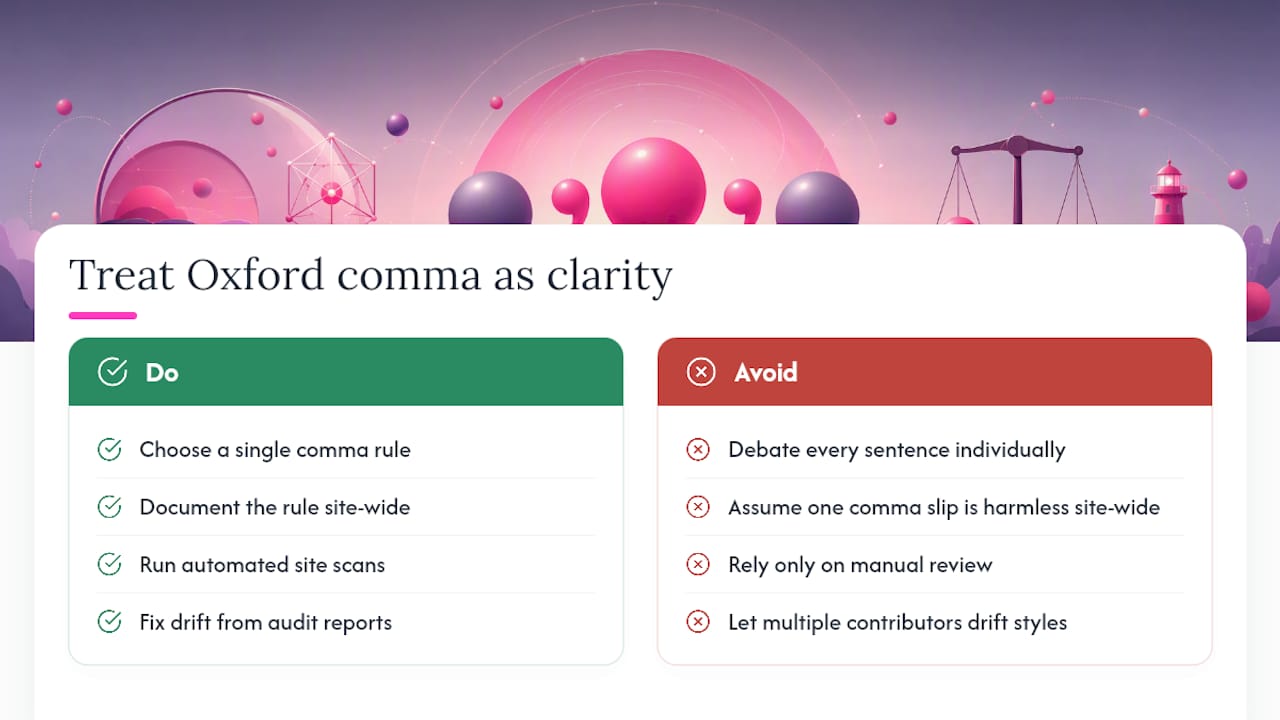
- Inconsistency within one document. A page that uses the comma in paragraph two and drops it in paragraph six looks careless, even if each individual sentence is grammatically fine. Fix it by running a find-and-check pass, or by using an automated scan that flags inconsistent punctuation across a whole site rather than page by page.
- Author and citation lists with the wrong convention. APA, MLA, and Chicago each treat ampersands and serial commas slightly differently in reference lists, so a comma correct in one citation style can be wrong in another. Check the specific manual before formatting a bibliography, not just the general writing rule.
- Corporate and legal copy where the missing comma changes meaning. Job titles, credits, and clause lists in contracts are exactly where the “parents, Beyoncé and Jay-Z” problem turns costly. Read the sentence back and ask whether a stranger could plausibly misread it; if so, add the comma or restructure.
- Treating the comma as a spelling error rather than a style choice. Some writers “correct” a colleague’s omitted comma as though it were objectively wrong. It isn’t, unless your house style says otherwise, so raise it as a style-consistency note, not a grammar correction.
Why we treat the Oxford comma as a clarity tool, not a house style badge
Most of the online argument about the Oxford comma treats it as a tribal marker: you’re either a “with” person or a “without” person, and the discussion stops there. That framing misses the point. The comma isn’t a personality trait. It’s a tool that occasionally prevents a genuinely embarrassing misreading, and the rest of the time, it’s cosmetic.
What surprises people is how rarely the choice actually matters at the sentence level, and how much it matters at the document level. One inconsistent comma in a blog post won’t lose you a reader. Fifty inconsistent commas across a site, mixed in with typos and mismatched terminology, start to read as carelessness, and carelessness is what erodes trust in a brand’s writing faster than any single grammar slip.
That’s really an editorial workflow problem more than a punctuation problem. Humans reviewing copy manually tend to catch the big ambiguous sentences and miss the quiet inconsistencies scattered across dozens of pages. Automated checks are better suited to that particular job: spotting where a style rule has drifted across a site, not just whether one sentence reads oddly.
We’d rather you pick a rule, document it, and use a tool built for checking grammar mistakes across website content to keep that rule consistent than have you agonise over every individual sentence. Clarity, applied consistently, beats punctuation purism every time.
— Website
The way you punctuate lists across a website tells readers something about how carefully the rest of the site was built, so treat the Oxford comma as a consistency signal worth checking site-wide, not just sentence by sentence.
Even careful writers drift on this rule once a site has multiple contributors, several page types, and months of accumulated content. A blog post from January might use the comma consistently while a product page from August drops it entirely, and neither writer necessarily notices. That’s precisely the kind of inconsistency Websitespellchecker is built to catch: it scans an entire website in one pass, flags inconsistent punctuation and phrasing alongside spelling errors, and gives you a report you can act on rather than a vague sense that “something feels off.” For agencies and marketing teams managing client sites, the downloadable audit report makes it straightforward to show exactly where style has drifted and fix it in one pass, and interface and microcopy teams facing the same clarity questions in shorter strings will find similar thinking in UX writing guidance for concise copy.
Key Takeaways
Clarity should decide your Oxford comma usage: follow your chosen style guide by default, but always add the comma when omitting it would create ambiguity.
| Point | Details |
|---|---|
| Definition | The Oxford comma sits before the final “and” or “or” in a list of three or more items. |
| Style dependent | Chicago, APA, and MLA recommend it; AP and The New York Times typically omit it. |
| Use it for ambiguity | Add it whenever a sentence could otherwise be misread, whatever your default style says. |
| Complex lists need more | Items with internal commas or conjunctions usually need semicolons, not just one extra comma. |
| Consistency matters most | Document your chosen rule once and apply it across every page, not sentence by sentence. |
Where can you check the official rules yourself?
For the exact wording of each rule, go to the primary manuals rather than secondary summaries, and check which edition or year you’re citing.
- The Chicago Manual of Style — the punctuation chapter covers serial comma usage in every current edition.
- The AP Stylebook — updated annually; check the comma entry for the current year’s wording.
- MLA Handbook — punctuation guidance sits within the general style section.
- Scribbr’s Oxford comma guide — a clear secondary summary with examples across major style guides.
- Wikipedia’s serial comma entry — useful background on history and regional usage patterns.
Always confirm against the current edition before citing a rule formally, since style manuals do revise their punctuation guidance between editions.