SEO tech audit checklist: spelling and grammar guide

What is an SEO technical audit checklist for UK websites?
A technical SEO audit checklist is a structured set of checks that reveals what is holding your website back from ranking well and earning reader trust. When you add spelling and grammar to that checklist, you are covering one of the most overlooked areas of SEO performance. Critical technical SEO issues quietly reduce search visibility across a large proportion of websites, and language errors are a significant contributor.
For UK websites, the stakes are specific. Search engines assess content quality, and poorly written copy chips away at trust with both users and algorithms. An automated approach using tools built for British English is the practical way to catch errors at scale.
Key language issues that affect UK site SEO include:
- Inconsistent British English spelling (e.g. “colour” vs “color,” “organise” vs “organize”)
- Missing or misplaced apostrophes
- Homophone confusion (“their/there/they’re,” “its/it’s”)
- Punctuation errors that disrupt sentence clarity
- Awkward phrasing and missing words that reduce readability scores
These errors do not just frustrate readers. They signal low content quality to search engines, which can suppress rankings directly.
Table of Contents
Key steps in your SEO tech audit checklist for spelling and grammar
A well-run website audit checklist combines regular comprehensive reviews with lighter, frequent checks. Here is how to build spelling and grammar into that workflow effectively.
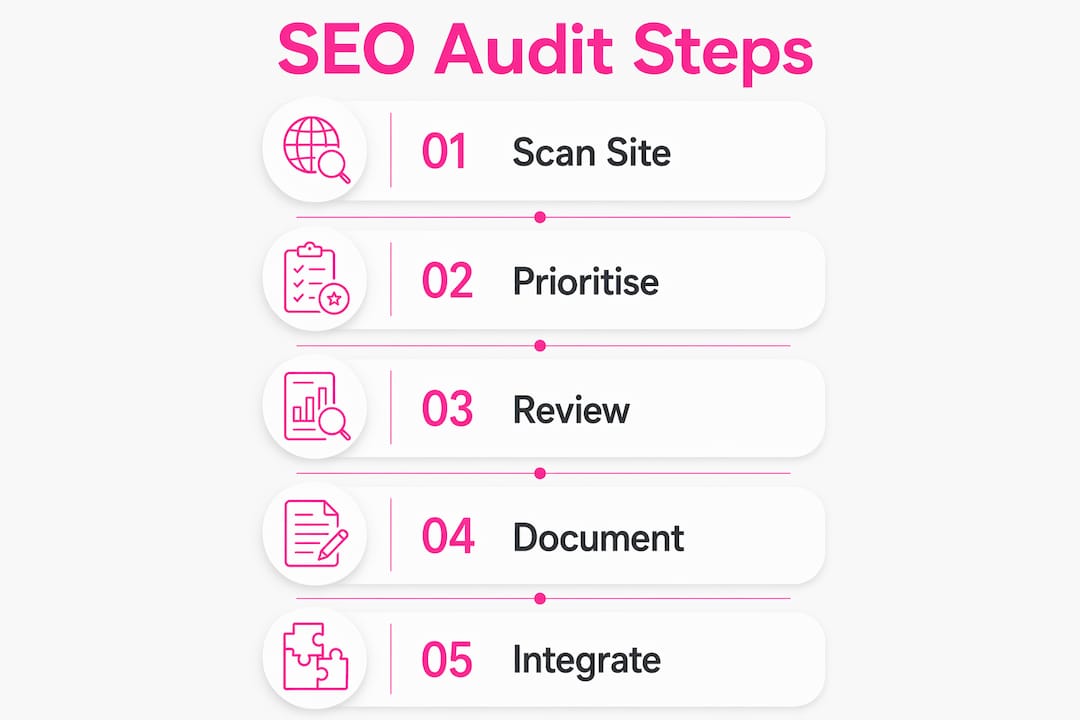
1. Run an automated whole-site scan first
Start broad. Automated scanning saves significant time compared to manual checks and catches errors across every page in one pass. Websitespellchecker uses AI to scan your entire site instantly, flagging spelling mistakes, grammatical errors, awkward phrasing, and missing words. It applies UK English dictionaries, which means you get results relevant to British spelling conventions rather than generic American English defaults.
2. Prioritise findings by business impact
Not every error deserves the same urgency. Experts recommend fixing the highest-impact issues first to avoid analysis paralysis. For spelling and grammar, prioritise:
- P0: Errors on your homepage, product pages, and conversion pages
- P1: Errors on high-traffic blog posts and service pages
- P2: Minor issues on low-traffic or supplementary pages
This mirrors the broader technical SEO prioritisation model used by B2B teams, where crawlability and indexability issues take P0 status and content quality sits at P1.
3. Interpret automated reports carefully
Automated tools can flag false positives, particularly with technical jargon, brand names, or specialist terminology. Tools built for UK English reduce this problem by applying region-specific dictionaries and contextual language rules. When reviewing your Websitespellchecker report, mark known exceptions and configure bespoke scan settings so recurring false positives do not clutter future results.
Pro Tip: Review flagged items on your highest-value pages manually. Automated scans give you breadth; a human eye on key content gives you the quality assurance that converts visitors.

4. Document every finding systematically
A fix-and-forget approach leads to the same errors resurfacing. For each issue, record the affected URL, a brief description of the error, its estimated impact on user trust or rankings, and who is responsible for fixing it. Websitespellchecker’s scan history tracking lets you compare results over time, so you can see whether fixes have held and catch regressions after site updates.
5. Integrate checks into your ongoing SEO workflow
Spelling and grammar audits should not be a one-off exercise. UK best practices recommend combining comprehensive periodic audits with lighter, frequent reviews. Schedule automated scans after any content update, site migration, or CMS change. You can learn more about scanning your site for errors effectively as part of a repeatable process.
Fixing spelling and grammar issues has a measurable effect. Websitespellchecker’s own data shows that improving language quality on UK websites has demonstrably increased SEO rankings and user trust.
Ready to add automated spell and grammar checking to your SEO audit? Websitespellchecker for business owners gives you instant, whole-site results with no monthly subscription.
Key takeaways
Automated UK English spell and grammar checking is a practical, high-impact addition to any technical SEO audit checklist that directly supports rankings and user trust.
| Point | Details |
|---|---|
| Language errors affect rankings | Spelling and grammar issues signal low content quality to search engines, suppressing visibility. |
| Prioritise by page value | Fix errors on conversion and high-traffic pages first before addressing lower-priority content. |
| Use UK-specific tools | Tools like Websitespellchecker apply British English dictionaries, reducing irrelevant false positives. |
| Document and track fixes | Record affected URLs, impact, and ownership to prevent errors from resurfacing after updates. |
| Audit regularly, not once | Schedule automated scans after every content update or site change to catch regressions early. |