Make Pages AI Readable: Spelling and SEO for Content Teams

Spelling and grammar are not a direct Google ranking factor, but they act as a quality multiplier that shapes trust, engagement and machine interpretation, all of which feed straight back into your search performance. Google has never confirmed spelling as an algorithmic signal, yet errors erode the trust and engagement metrics search engines do measure. The fix scales far better with a tool like Website SpellChecker than with another round of manual proofreading.
TL;DR:
- Typos and grammatical errors primarily influence trust, engagement, and machine understanding, indirectly affecting SEO through user behavior and content sharing.
- Errors in titles, headings, and product information have the most immediate negative impact on traffic, conversions, and backlink growth.
- Prioritizing fixes on high-traffic and commercial pages yields faster SEO results than manual checks of low-traffic content.
- Automated tools like Website SpellChecker streamline large-scale website audits, helping maintain consistent quality across hundreds of pages.
- Building ongoing editorial quality routines reduces emergency fixes, improves organic performance, and substantiates your return on investment.
Table of Contents
- How spelling and grammar affect SEO through direct and indirect pathways
- What Google and human quality raters actually say about writing quality
- Readability, AI search, and how machines actually parse your pages
- Where errors matter most and how to prioritise fixes
- A practical proofreading checklist for SEO-friendly pages
- Auditing your whole site: a practical example of scale
- Editorial quality as a growth lever, not a chore
- How Website SpellChecker automates proofreading across your whole site
- Sources
How spelling and grammar affect SEO through direct and indirect pathways
A “direct ranking factor” is something Google’s algorithm scores explicitly, like page speed or mobile usability. Spelling isn’t on that list. It’s a “quality multiplier” instead: it doesn’t get scored directly, but it changes how people and machines respond to your content, and that response gets scored.
Three pathways carry that influence:
- User behaviour: a page riddled with typos reads as careless, so visitors bounce faster and spend less time reading, both signals Google does track.
- Editorial reach: journalists, bloggers, and other sites rarely link to or share content that looks unpolished, quietly capping your backlink growth.
- Machine interpretation: garbled syntax makes it harder for crawlers and language models to identify your core topic, weakening how confidently your page gets indexed and summarised.
None of these pathways trips an algorithm switch on its own. Together, they decide whether your content earns the trust that turns into clicks, shares, and links.
What Google and human quality raters actually say about writing quality
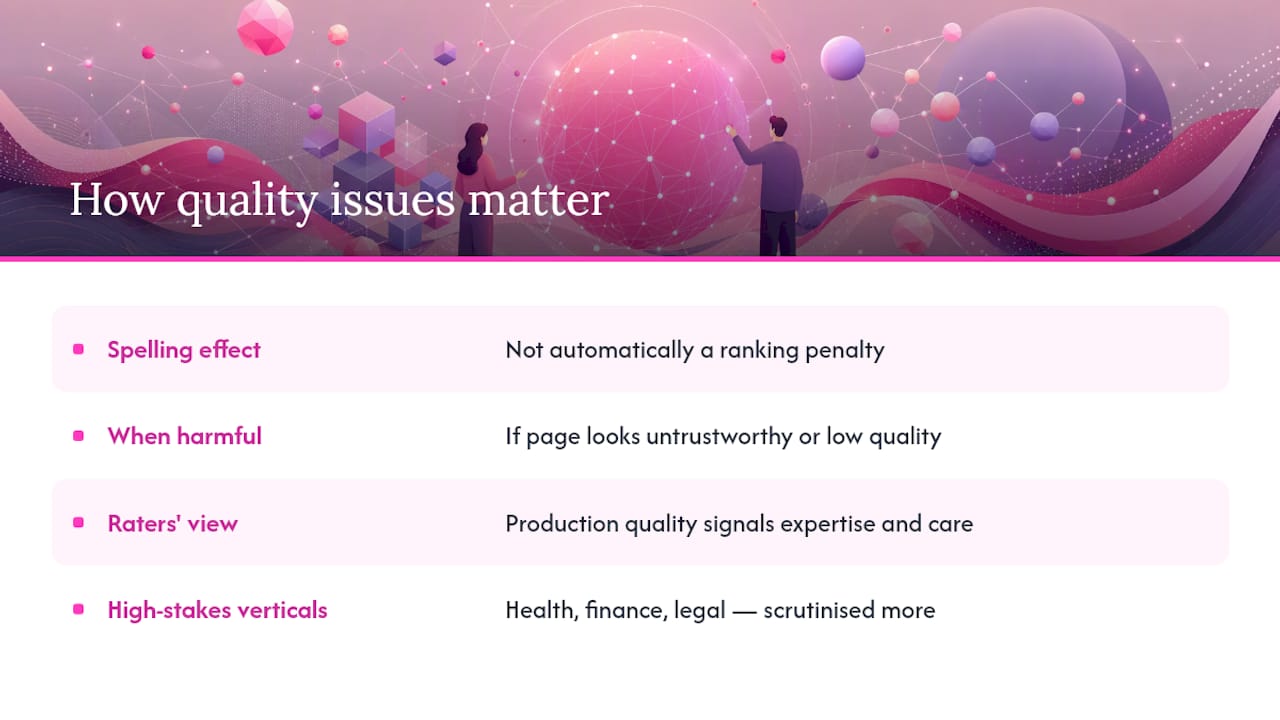
Google’s own John Mueller has addressed this directly, describing spelling as something of a grey area rather than a clean rule.
Spelling and grammar issues don’t automatically hurt rankings, but if they make a page hard to recognise as high quality, or hard to trust, that’s where problems start.
That framing matters more than it sounds. Google’s human quality raters, who help calibrate the algorithm’s sense of what “good” looks like, are trained to treat production quality as a visible marker of expertise and care. Sloppy production quality reads as a weaker signal of expertise even when the underlying information is accurate.
The stakes rise sharply in health, finance, and legal content. These are the verticals Google scrutinises hardest for trustworthiness, and a misplaced decimal point or a garbled dosage instruction does more damage there than a typo on a recipe blog ever would.
Readability, AI search, and how machines actually parse your pages
Search is no longer just ten blue links. AI Overviews, chatbots, and semantic search features now read your page, extract a claim, and repeat it, sometimes without a click ever reaching your site. That extraction step rewards clarity.
The pattern holds across the evidence: short, declarative sentences with one idea per paragraph are easier for language models to lift and summarise accurately than dense, clause-heavy prose. A sentence buried under three subordinate clauses forces a model to guess which part is the actual claim.
Compare these two:
Before: “Although many businesses assume that spelling errors, which can appear anywhere from headlines to footnotes, are a minor cosmetic issue, they can in fact undermine credibility.”
After: “Spelling errors look cosmetic. They aren’t. They undermine credibility.”
Readability indices like Flesch–Kincaid, ARI, and Gunning Fog won’t catch every typo, but they flag the dense paragraphs most likely to confuse both readers and machines, making them a useful diagnostic pass before publishing and essential for optimizing content for AI search success.
Where errors matter most and how to prioritise fixes
Not every typo carries equal weight. A misspelling buried in paragraph nine of a low-traffic blog post costs you almost nothing. The same error in a headline or a checkout button can cost you a sale.
Fix these first:
- Title tags and meta descriptions, the first thing a searcher reads before clicking
- Headings and subheadings, which set expectations for the whole page
- Product names and pricing, where a typo can look like a scam
- Calls-to-action and form labels, where confusion means abandoned carts
Pro Tip: Fixing a typo in a meta description often lifts click-through rate faster than fixing ten errors buried in body copy, simply because more eyes land on that snippet.
Triage by traffic first, commercial pages second, and everything else third.
A practical proofreading checklist for SEO-friendly pages
Building error-checking into your workflow beats catching mistakes after publication. Here’s a sequence that works for teams of any size:
- Run an automated site scan before anything goes live.
- Proofread titles and meta descriptions separately from body copy. They’re easy to skip when you’re focused on the main text.
- Read the page aloud, or use text-to-speech. Your ear catches awkward phrasing your eye skips over.
- Get a second person to review before publishing. Writers miss their own mistakes.
- Keep a style guide that fixes your regional spelling convention, since inconsistent US/UK spelling confuses readers even when search engines handle it fine.
A simple responsibility chain keeps this from slipping:
- Writer drafts and self-edits.
- Editor reviews for tone and clarity.
- A tool like Website SpellChecker scans before publication.
- The page goes live.
- Traffic and engagement get monitored afterwards.
Auditing your whole site: a practical example of scale
A one-page proofread is manageable. A 400-page website is not, not without a scanning tool doing the heavy lifting. A site-wide scan typically surfaces misspellings, inconsistent product naming, missing or broken alt text, meta-title errors, and high-visibility typos on pages you’d never think to check manually.
The triage that follows matters more than the scan itself. Prioritising fixes on high-traffic and commercial pages produces measurable conversion gains far faster than working through errors alphabetically or by page age.
| Priority tier | Page type | What to fix first |
|---|---|---|
| Tier 1 | High-traffic landing pages | Title tags, headings, CTAs |
| Tier 2 | Commercial/product pages | Pricing, product names, form labels |
| Tier 3 | Mid-traffic blog content | Body copy, internal links |
| Tier 4 | Low-traffic archive pages | Batch fixes, the lowest urgency |
Once fixes go live, track click-through rate, bounce rate, pages-per-session, and backlink acquisition over the following weeks. A change-over-time report tells you whether the editorial effort actually moved the numbers, not just whether the typos disappeared.
Editorial quality as a growth lever, not a chore
Perfect prose isn’t the goal. Credible, easily parsed prose is. Every business I’ve seen treat editorial quality as a recurring line item, not a one-off cleanup, ends up with fewer emergency fixes and steadier organic performance. Build a lightweight style guide, schedule quarterly audits, and track CTR and bounce rate before and after fixes. That’s how you prove the ROI instead of guessing at it.
— Website
How Website SpellChecker automates proofreading across your whole site
Manually checking every page for spelling and grammar errors doesn’t scale past a handful of pages, and that’s exactly the gap Website SpellChecker was built to close. Its AI scanning technology checks entire websites in one pass, flags inconsistent naming and awkward phrasing alongside straightforward typos, and tracks changes over time so you can see whether your fixes are actually holding.

For agencies managing client sites, developer-focused integrations plug scanning directly into existing workflows. For marketing teams, downloadable, shareable PDF reports turn a scan into something you can hand to stakeholders without translating it first. The result buyers see most often: faster remediation, less time spent on manual QA, and cleaner public-facing copy that holds up under scrutiny, whether from a visitor, a journalist, or an AI summary tool.
If you’re responsible for a website’s credibility, start with a scan of your own site and see what a full audit actually surfaces.
Sources
- Grammar and spelling google ranking factor? — Rotatedigital
- Small language models and SEO — Uposition Agency