What is content optimisation: your 2026 guide

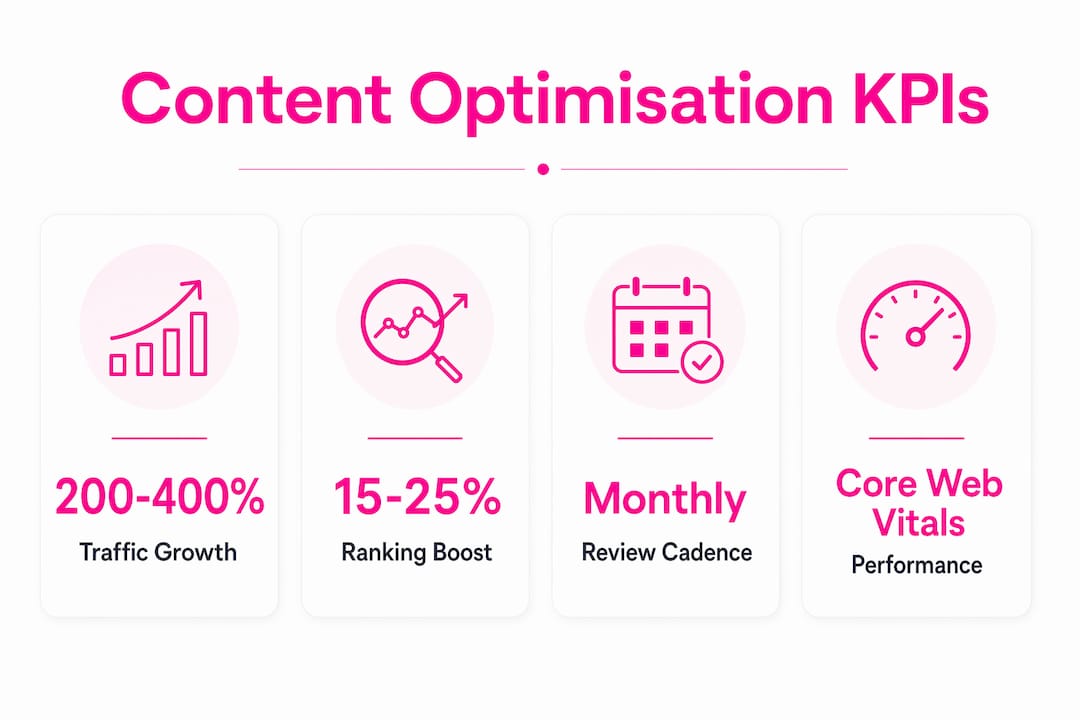
Content optimisation is the process of systematically improving digital content to increase its visibility, relevance, and engagement across search engines and AI-powered answer platforms. The discipline combines traditional SEO best practices, technical performance standards, and newer AI-readiness techniques such as Answer Engine Optimisation (AEO) and Generative Engine Optimisation (GEO). Content freshness alone can deliver a 15–25% ranking boost for competitive queries. That single fact tells you how much is at stake when you leave pages untouched for months. This guide explains every layer of content optimisation, from foundational SEO to AI citation strategy, so you can apply the right techniques to your website right now.
What is content optimisation and what does it cover?
Content optimisation is a systematic process with three interlocking pillars: SEO, content quality, and technical performance. Each pillar reinforces the others. Weak technical performance undermines great writing, and great writing cannot compensate for poor keyword targeting.

SEO fundamentals
Keyword targeting, metadata, backlinks, and Google’s E-E-A-T principles (Experience, Expertise, Authoritativeness, and Trustworthiness) form the bedrock of SEO content. Keyword targeting means matching the exact language your audience uses in search queries. Metadata, specifically title tags and meta descriptions, signals relevance to search engines before a user even clicks. Backlinks from credible sources confirm authority. E-E-A-T tells Google that a real, qualified person produced the content.
Content quality factors
Depth, freshness, accuracy, and alignment with user intent define quality content. A page that answers a question thoroughly outperforms one that skims the surface, even if both target the same keyword. Google’s guidance is direct: optimise for users, not algorithms, and produce unique, helpful, and satisfying content. That means going beyond what competitors publish and adding original insight or data.
Technical performance standards
Technical optimisation sets the floor for ranking potential. Core Web Vitals targets are Largest Contentful Paint (LCP) under 2.5 seconds, First Input Delay (FID) under 100ms, and Cumulative Layout Shift (CLS) under 0.1. Pages that miss these thresholds face ranking penalties regardless of content quality. Mobile responsiveness and structured data markup complete the technical picture.
| Technical metric | Target value | What it measures |
|---|---|---|
| LCP | Under 2.5s | Page load speed for main content |
| FID | Under 100ms | Responsiveness to user input |
| CLS | Under 0.1 | Visual stability during load |
Pro Tip: Run a Core Web Vitals audit on your top five pages first. Fixing performance on high-traffic pages delivers the fastest return on your technical investment.
How do AEO and GEO change content optimisation strategies?
AI content optimisation now focuses on earning citations and trust in AI-generated answers, not just clicks. This shift requires rethinking both content structure and technical signals. Two frameworks define this new territory: Answer Engine Optimisation (AEO) and Generative Engine Optimisation (GEO).
AEO targets AI answer engines such as Perplexity and Google’s AI Overviews. The goal is to have your content extracted and cited as the authoritative answer to a query. GEO extends that ambition to generative AI platforms, where success is measured by earning citations in AI-generated responses rather than ranking in a traditional results list.
Practical tactics for AEO and GEO include:
- Write answer-first content blocks of 75–150 words that are self-contained. AI models extract these blocks without needing surrounding context.
- Use question-led headings throughout your content. They align with natural language queries and improve AI extractability.
- Apply FAQPage and Article schema markup. Structured data types like these significantly increase the probability of AI systems citing your content.
- Implement server-side rendering. Many AI crawlers cannot execute client-side JavaScript, so pages that rely on it may be invisible to AI indexing bots.
- Keep paragraphs short and factual. Conversational, jargon-free prose is easier for AI models to parse and reproduce accurately.
| Approach | Primary goal | Key signal |
|---|---|---|
| Traditional SEO | Rank in search results | Keywords, backlinks, E-E-A-T |
| AEO | Appear in AI answer boxes | Answer blocks, FAQ schema |
| GEO | Earn citations in AI responses | Structured data, SSR, authority |
Pro Tip: Test your pages by asking an AI assistant the question your page answers. If the AI does not cite your site, your answer block is likely too long, too vague, or buried too deep in the page.
How to implement content optimisation techniques effectively
Effective implementation starts with a content audit. Review your existing pages and identify which ones rank on page two or three of search results, which ones have outdated statistics, and which ones lack structured data. These are your highest-priority targets.
Follow this process for each priority page:
- Refresh the content. Update statistics, add new examples, and remove outdated claims. Pages updated within the last 90 days outperform stale content by up to 25% for competitive queries.
- Restructure for AI readability. Add a direct answer in the first paragraph. Break long sections into shorter ones with question-led H2 headings. Add an FAQ section with FAQPage schema.
- Fix technical issues. Compress images to hit LCP targets. Remove render-blocking scripts. Test mobile responsiveness on real devices, not just browser simulators.
- Check content accuracy. Spelling errors and grammatical mistakes chip away at trust and signal low quality to both users and search engines. Tools like Websitespellchecker scan entire websites in one pass, catching errors that manual checks miss.
- Add internal links. Connect related pages to distribute authority and help users find deeper content on your site.
Prioritise pages that already attract some organic traffic. A page ranking in position 8 is far easier to push to position 3 than a page with no ranking history at all. Avoid the common mistake of rewriting pages that already perform well. Unnecessary rewrites can disrupt existing ranking signals and cause temporary traffic drops.
Pro Tip: Set a quarterly content review calendar. Assign each high-value page a review date and treat it like a product update, not a one-off task.
How do you measure the impact of content optimisation?
Measurement confirms whether your optimisation efforts are working and tells you where to focus next. The four key performance indicators are organic traffic, engagement rate, ranking position changes, and AI citation rate.
Organic traffic shows whether more people are finding your content through search. Engagement rate, specifically time on page and scroll depth, reveals whether visitors find the content genuinely useful. AI search results deliver higher-quality clicks with more engaged visitors, so tracking engagement alongside traffic gives a fuller picture. Ranking position changes confirm that your SEO signals are strengthening over time.
AI citation rate is the newest metric. Check whether your content appears in AI Overviews, Perplexity answers, or ChatGPT responses for your target queries. This is now a direct measure of GEO and AEO success.
| KPI | What to track | Review frequency |
|---|---|---|
| Organic traffic | Sessions from search engines | Monthly |
| Engagement rate | Time on page, scroll depth | Monthly |
| Ranking position | Position for target keywords | Fortnightly |
| AI citation rate | Appearances in AI-generated answers | Monthly |
Content optimisation done correctly produces traffic increases of 200–400% within six months. That figure assumes a consistent approach combining SEO, freshness, and technical best practices. Sporadic updates produce sporadic results. Build a repeatable process and the numbers follow.
Key takeaways
Effective content optimisation combines SEO fundamentals, technical performance, and AI-readiness techniques to produce sustained gains in visibility, engagement, and citation rates.
| Point | Details |
|---|---|
| Freshness drives rankings | Updating content within 90 days can yield a 15–25% ranking boost for competitive queries. |
| Technical standards matter | Target LCP under 2.5s, FID under 100ms, and CLS under 0.1 to meet Google’s page experience requirements. |
| AI needs structured content | Use FAQPage schema, answer-first blocks of 75–150 words, and server-side rendering for AI citation success. |
| Audit before you rewrite | Prioritise pages already attracting traffic; avoid disrupting pages that already rank well. |
| Measure AI citations | Track appearances in AI-generated answers alongside organic traffic and ranking positions. |
My honest view on content optimisation in the AI era
The most common mistake I see is treating content optimisation as a one-time project. Marketers publish an updated page, see a short-term ranking lift, and move on. Six months later, the page has slipped back because competitors kept updating and the technical standards shifted.
The shift to AEO and GEO has made this problem worse. Traditional SEO rewarded pages that accumulated backlinks over time. AI citation rewards pages that are currently accurate, well-structured, and technically accessible. That is a fundamentally different dynamic. A page that was excellent in 2024 may be invisible to AI systems in 2026 if it has not been updated to include structured data and answer-first formatting.
The encouraging part is that the core principle has not changed. Google’s own guidance still points to the same truth it always has: fulfil real user needs with unique content. The techniques evolve, but the goal stays constant. If you write for people first and structure for machines second, you will stay ahead of most of your competitors.
The practical priority for 2026 is this: pick your ten most important pages, run a full audit covering content freshness, structured data, Core Web Vitals, and linguistic accuracy, then fix them in that order. Do not wait until you have a perfect system. Start with one page this week.
— Websitespellchecker
How Websitespellchecker supports your optimisation efforts
Content quality is the foundation every other optimisation technique builds on. Spelling errors and grammatical mistakes undermine trust before a user reads a single paragraph, and they signal low quality to search engines at the same time.
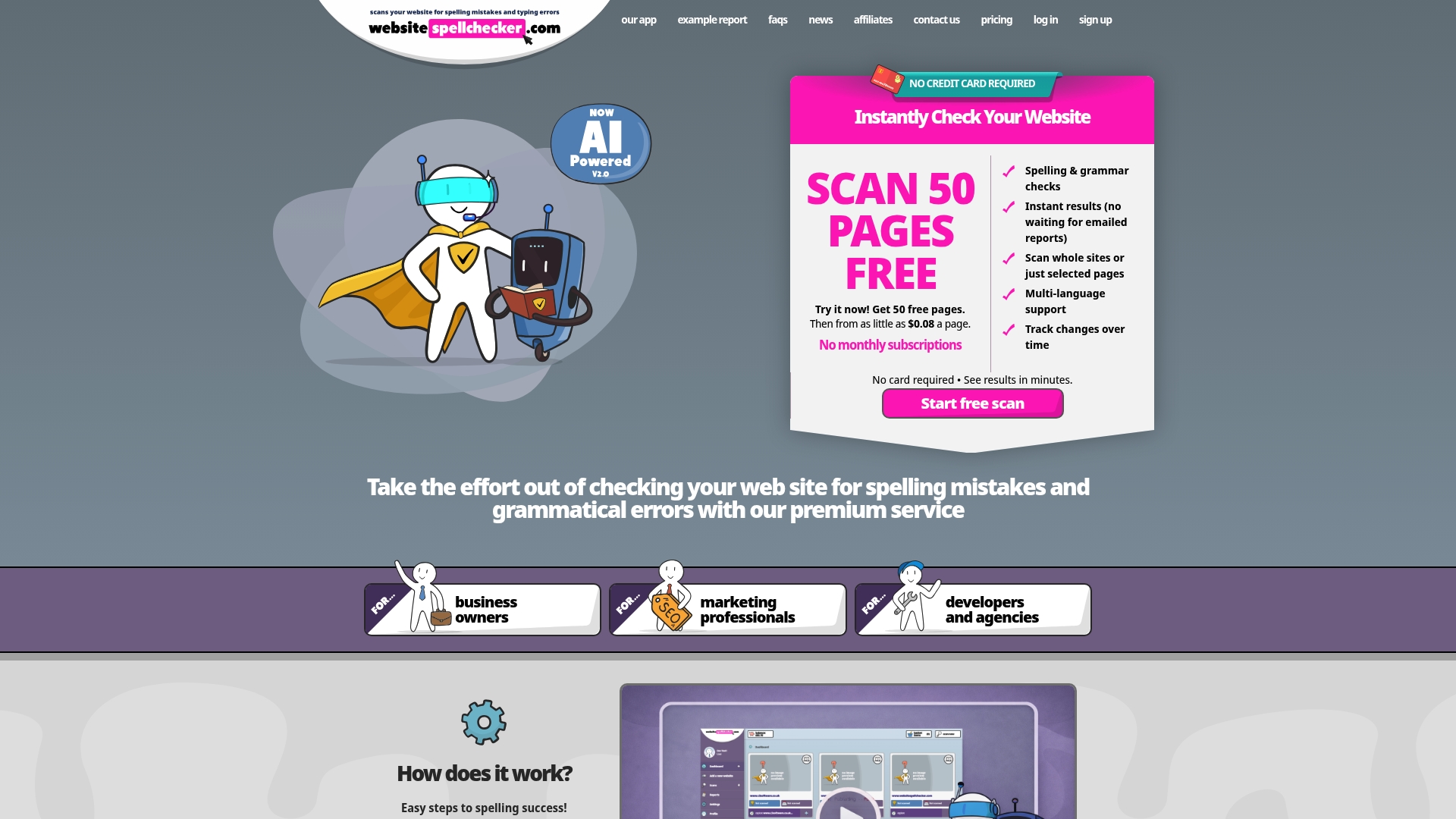
Websitespellchecker scans your entire website in one pass using AI technology, catching errors across every page instantly. It tracks changes over time, so you can see whether new content meets your quality standards before it affects your rankings. For business owners who want to maintain a professional, credible website without spending hours on manual checks, it is a practical and reliable solution. You can also review a detailed spell check report to identify exactly where errors are concentrated and prioritise fixes by page importance.
FAQ
What is content optimisation in simple terms?
Content optimisation is the process of improving digital content so it ranks higher in search results, satisfies user intent, and earns citations in AI-generated answers. It covers writing quality, keyword targeting, technical performance, and structured data.
How does content optimisation differ from SEO?
SEO is one component of content optimisation. Content optimisation also includes technical performance standards such as Core Web Vitals, AI-readiness techniques like AEO and GEO, and content quality factors such as freshness and depth.
How often should I update my content?
Pages updated within the last 90 days can achieve a 15–25% ranking boost for competitive queries. A quarterly review cycle for high-value pages is a practical standard for most businesses.
What is Answer Engine Optimisation (AEO)?
AEO is the practice of structuring content so AI answer engines can extract and cite it directly. Key techniques include writing self-contained answer blocks of 75–150 words, using FAQPage schema, and implementing server-side rendering.
Does spelling affect content optimisation?
Poor spelling reduces user trust and signals low content quality to search engines, both of which negatively affect rankings. Maintaining linguistic accuracy is a foundational best practice for any content optimisation strategy.